
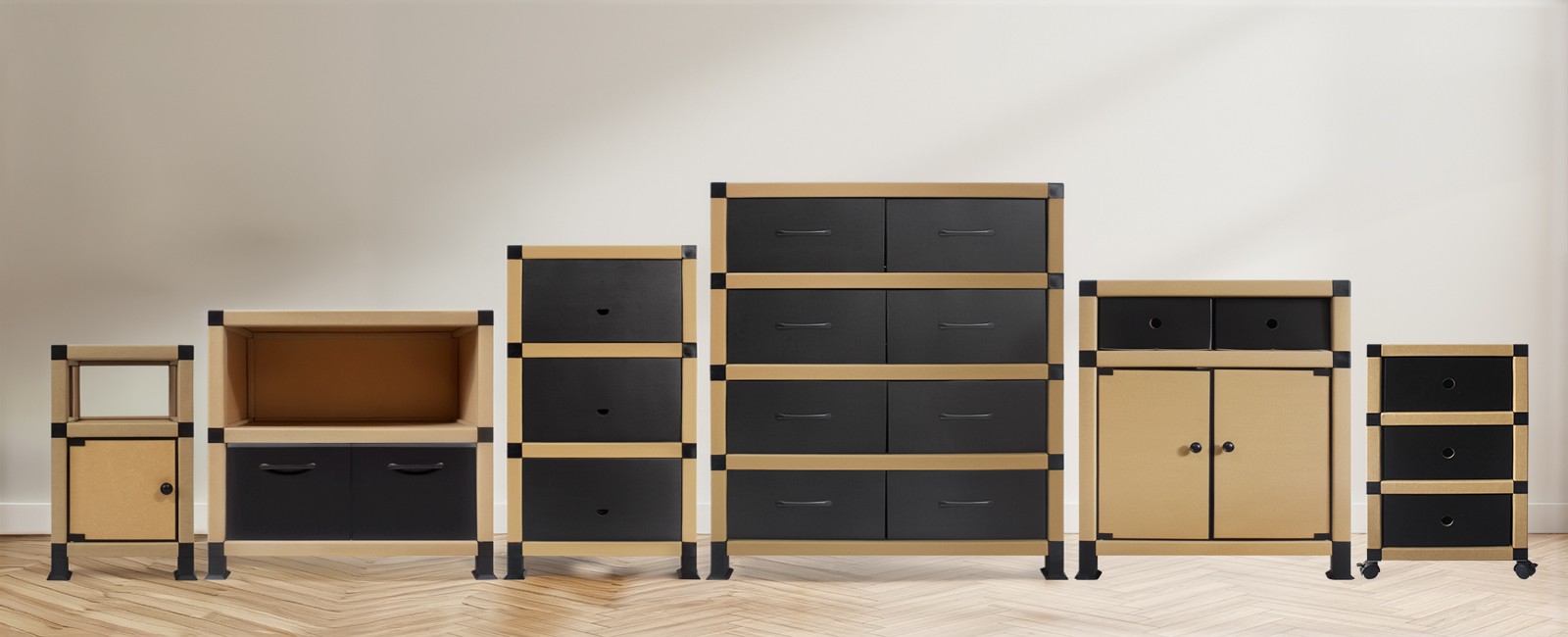
China has emerged as a global leader in sustainable furniture production, with hundreds of manufacturers dedicated to reducing environmental impact while delivering high-quality products. An eco furniture manufacturer in China specializes in designing and producing furniture using renewable materials, low-emission processes, and circular-economy principles. From bamboo and recycled wood to innovative paper-based structures, these manufacturers are reshaping the global furniture industry's approach to sustainability.
Over the past decade, China's furniture industry has undergone a significant green transformation. Driven by stricter international environmental regulations, rising domestic consumer awareness, and government initiatives promoting low-carbon manufacturing, eco-friendly production has shifted from a niche offering to a baseline competitive requirement. Major Western import markets have introduced far-reaching legislation such as the EU Deforestation Regulation (EUDR), which mandates GPS-level traceability for all timber products, and the Ecodesign for Sustainable Products Regulation, which paves the way for mandatory Digital Product Passports.
Domestically, China has also raised its standards. The ENF grade — the strictest formaldehyde emission tier, capped at ≤0.025mg/m³ — has been widely adopted as a baseline standard. Traditional manufacturing hubs like Foshan and Anji have replaced small workshops with modern factories equipped with complete pollution control infrastructure. This combination of external pressure and internal upgrading has created a robust ecosystem of sustainable furniture manufacturers across the country.
Chinese eco furniture manufacturers work with a diverse range of sustainable materials, each suited to different product categories and market segments. Bamboo, a rapidly renewable resource that matures in 3–5 years compared to decades for hardwood, is extensively used for chairs, tables, and flooring. Fast-growing timber species like poplar and paulownia, when sourced from FSC-certified plantations, provide a sustainable alternative to slow-growing hardwoods.
Renewable composite panels pressed from crop straw and bamboo fiber have also gained significant traction in mass-market furniture and commercial fit-out projects. Perhaps most innovative of all are paper-based furniture systems, which use high-strength kraft paper tubes and reinforced cardboard panels to create surprisingly durable and fully recyclable furniture. Companies like MINHOU UNIMAX have perfected this approach, proving that paper furniture can be both practical and stylish while dramatically reducing environmental footprint.
The manufacturing process for eco-friendly furniture varies by material type, but all share common principles: minimizing waste, reducing energy consumption, eliminating toxic chemicals, and maximizing recyclability. Let us examine the key stages across different material categories.
The process begins with responsible raw material procurement. Reputable manufacturers source wood from FSC-certified forests or use fast-growing plantation timber. For paper-based furniture, high-strength kraft paper derived from managed forestry operations is the primary input. Bamboo is sourced from sustainable groves in provinces like Fujian and Zhejiang, where it grows naturally without pesticides or fertilizers. Every batch of material is traced and documented to ensure compliance with international standards.
One of the most significant advancements in Chinese eco furniture manufacturing is the widespread adoption of bio-based adhesives. Traditional particleboard and MDF relied heavily on urea-formaldehyde resin glues, which released harmful VOCs over time. Today, manufacturers use soy protein glue, lignin glue, and MDI formaldehyde-free adhesives at industrial scale. For surface finishing, water-based coatings and UV curing finishes have largely replaced solvent-borne PU paints, dramatically reducing VOC emissions.
Paper furniture manufacturers employ specialized processing techniques. The paper is transformed into high-strength tubes through precise winding and layering techniques combined with eco-friendly binders. These tubes are then cut to exact specifications, forming the structural backbone of modular furniture systems. Specialized multi-directional connectors — typically made from durable recycled plastics — are molded to precise tolerances, enabling tool-free assembly and long-lasting structural integrity.
Leading smart factories in China's furniture manufacturing hubs have integrated AI-powered CNC nesting optimization systems. This technology dramatically boosts material yield for timber panels and upholstery fabrics, slashing raw material wastage by up to 15–20% compared to traditional cutting methods. Every component is subjected to rigorous quality control checks to ensure consistency, dimensional accuracy, and structural durability.
Forward-thinking Chinese manufacturers design for circularity from the earliest stages. Rather than using permanent adhesives that prevent disassembly, they deploy modular connection systems that allow consumers to easily separate different material components for recycling at the end of the product's life. For paper-based furniture, the modular design enables tool-free assembly — customers simply connect pre-cut tubes and panels using specialized multi-prong connectors, with no screws, nails, or complicated hardware required.
Before leaving the factory, eco furniture products undergo comprehensive testing. This includes formaldehyde emission tests to verify ENF or E0 grade compliance, load-bearing capacity tests, durability assessments, and surface performance tests. Leading manufacturers hold internationally recognized certifications such as FSC Chain of Custody, OEKO-TEX Standard 100, GREENGUARD Gold, and BSCI, providing global buyers with verified evidence of their sustainability credentials.
Among China's eco furniture innovators, MINHOU UNIMAX stands out for its pioneering work in paper-based furniture. Based in Fuzhou, Fujian, the company has developed a patented system using high-strength paper tubes, reinforced paper panels, and multi-prong polypropylene connectors. The manufacturing process is remarkably efficient: sustainably sourced kraft paper is wound into tubes of varying diameters, treated for water and stain resistance, and precision-cut to specific lengths. These tubes form the structural framework, while reinforced cardboard panels provide shelving and surface areas.
The entire production process generates minimal waste. Offcuts and shavings are recycled back into the production cycle or used as biomass fuel. Because the furniture is flat-pack by design, shipping volume and associated carbon emissions are dramatically reduced compared to traditional assembled furniture. When a piece reaches the end of its life cycle, the paper components can be fully recycled through standard paper recycling streams, and the plastic connectors can be separated and reused — a true embodiment of the circular economy.
China's eco furniture manufacturers offer several distinct advantages. First, their integrated supply chains allow for efficient, cost-effective production without compromising on sustainability standards. Second, the scale of China's furniture industry enables rapid adoption of new technologies and materials — what starts as a niche innovation in one factory quickly spreads across entire industrial clusters. Third, Chinese manufacturers are highly adaptable, offering OEM and ODM services that allow global brands to customize eco-friendly furniture to their specific market needs.
Many factories have also invested heavily in renewable energy. Rooftop solar installations are increasingly common across furniture manufacturing hubs in Jiangxi, Zhejiang, and Guangdong, reducing both carbon emissions and energy costs. Wood dust and other production byproducts are collected through central extraction systems and processed into biomass pellet fuel for on-site energy recovery, creating a closed-loop manufacturing system that minimizes waste at every stage.
Looking ahead, several trends will continue to shape China's eco furniture manufacturing landscape. Digitalization will play an increasingly central role, with AI-driven design tools optimizing material usage and IoT sensors tracking production energy consumption in real time. The adoption of bio-based materials will expand beyond adhesives into structural components, as researchers develop new composites from agricultural waste products like rice straw and wheat husk.
Paper and cardboard furniture will likely see particularly strong growth, driven by urbanization, the rise of rental living, and increasing demand for flexible, affordable, and sustainable home furnishings. Manufacturers like MINHOU UNIMAX are at the forefront of this trend, continuously innovating their product designs and manufacturing processes to deliver furniture that meets both the practical needs and environmental values of modern consumers. As global awareness of climate change continues to grow, China's eco furniture manufacturers are well-positioned to lead the world in sustainable furniture production.
