
Buyers who are sourcing paper furniture from China for the first time tend to ask the same cluster of questions before they feel comfortable placing a bulk order. They want to know whether cardboard furniture is strong enough for real daily use, how it survives weeks inside a shipping container, whether the manufacturer can customize colors and sizes, and what certifications back up the environmental claims. These questions are reasonable, and a wholesale cardboard furniture exporter that has been manufacturing since 2009 should be able to answer every one of them clearly. This article brings together the most common questions buyers ask, grouped by theme, with straightforward answers drawn from the manufacturer's own product data and export experience.
The furniture is built from three structural components: high-strength kraft paper tubes, reinforced paper panels, and multi-prong polypropylene (PP) connectors. The paper tubes undergo a special treatment that gives them water and stain resistance on the surface. The connectors use a patented three-way and multi-prong design that distributes load across multiple contact points and allows the furniture to be assembled and disassembled repeatedly without weakening the joints. Plastic foot covers are added to the bottom of vertical tubes to keep them off the floor and protect against moisture.
This is probably the single most asked question, and the answer surprises most buyers. According to the manufacturer's published specifications, selected structures can support an adult weighing up to 80 kg, and a fully assembled bookshelf can carry a total load of 50 kg. A bedside table or side table holds everyday items like lamps, books, phones, and drinks without issue. These figures are the manufacturer's own claims, so wholesale buyers should request a sample and test the specific model they intend to distribute before committing to a large order, since load capacity varies by product size and configuration.
The manufacturer states that paper furniture commonly has a service life of approximately one to five years, depending on materials, construction, usage patterns, and indoor environment. Under suitable conditions, such as controlled humidity and protection from direct moisture, the service life can exceed five years. Cardboard furniture is best suited for light-use, storage, decorative, transitional, and flexible-space applications rather than permanent heavy-load core furniture. For buyers serving rental apartments, student housing, pop-up retail, or event staging, this lifespan aligns well with the intended use case.
The kraft paper tubes receive a surface treatment that provides water and stain resistance, meaning small spills can be wiped away without damaging the structure. However, the furniture is not waterproof. The manufacturer recommends keeping indoor humidity controlled, avoiding placement directly on wet floors, and using the plastic foot covers that come with each product. For cleaning, a dry cloth or mild detergent on a damp cloth handles most everyday marks. Prolonged exposure to standing water or humidity above 60 percent will degrade the paper over time.
Yes. The manufacturer offers full customization across its product range, which spans eight categories including bedside tables, bedroom wardrobes, sofa side tables, living room cabinets, home organizers, bookcases, children's desk and seating, and pet houses. Wholesale partners can select from a range of colors, adjust dimensions within the structural limits of the paper tube system, and add their own brand logo to both the product and the packaging. Custom colors typically require a minimum batch, so buyers should discuss specific shade requirements early in the negotiation.
The company provides both OEM (Original Equipment Manufacturing) and ODM (Original Design Manufacturing) services. Under OEM, the buyer provides the design specifications and the factory produces to those specs. Under ODM, the factory's in-house design team works with the buyer to develop new configurations using the existing paper tube and connector system. Because the connector system is modular, with three-way, four-way, and multi-prong options, the design possibilities extend well beyond the 33 standard products in the current catalog.
The manufacturer offers flexible MOQs that depend on the product type and level of customization. Stock items in standard colors and sizes carry a lower MOQ, while fully custom designs with unique colors, branding, or packaging require a higher minimum. Buyers should contact the sales team directly with their specific product and quantity requirements to receive an accurate MOQ quote. The company positions itself as accommodating both small retailers testing the market and large chains placing container-sized orders.
Every product is disassembled into its three component types (paper tubes, reinforced panels, and connectors) and packed separately inside corrugated cartons. This flat pack furniture approach serves two purposes: it protects the structural components during transit and it significantly reduces shipping volume compared to shipping fully assembled furniture. Lower shipping volume translates directly into lower freight costs per unit, which is one of the main competitive advantages of paper furniture over traditional wooden or metal furniture in export markets.
The manufacturer ships to countries around the world and has established export procedures for handling customs documentation, fumigation requirements, and destination-specific compliance. The flat-pack design makes ocean freight economical even for buyers ordering moderate quantities, because more units fit into a standard container than would be possible with assembled furniture. Buyers should confirm shipping terms (FOB, CIF, or other Incoterms) and destination port details when requesting a quote.
Lead times vary based on order size and the degree of customization. Standard products in stock colors generally ship faster, while custom designs requiring new color batches, branded packaging, or modified dimensions take longer. The manufacturer works with buyers to meet agreed deadlines and provides production progress updates. Buyers planning for seasonal sales cycles should factor in both production time and ocean transit time when placing orders, and should communicate target delivery dates early in the process.
MINHOU UNIMAX has been a member of BSCI (Business Social Compliance Initiative) and FSC (Forest Stewardship Council) for years. The company holds connector patents and has test reports covering formaldehyde emissions, load capacity, POP/PCP, cadmium, and phthalates. These reports are particularly relevant for buyers serving European and North American markets, where chemical compliance in furniture is strictly regulated. Buyers should request current copies of all certificates and test reports directly from the company before finalizing any compliance-sensitive sourcing decision.
Yes, samples are available for all products. The manufacturer encourages buyers to request a sample so they can evaluate the material quality, assembly process, and structural feel firsthand before committing to a wholesale order. Sample costs and shipping fees are typically quoted separately, and many suppliers apply the sample cost as a credit toward the bulk order once it is placed. Testing a sample is especially important for buyers who plan to customize the product, because it establishes the quality baseline for the production run.
The company states that its production includes quality control from material selection and precision cutting through to modular assembly. This means the kraft paper is inspected upon receipt, tubes are cut to specified dimensions, panels are checked for structural integrity, and connectors are tested for fit and load distribution. The patented connector design itself is a quality feature, because it reduces the number of failure points compared to adhesive-based or screw-based assembly. Buyers who want independent verification can arrange a third-party pre-shipment inspection, and the manufacturer accommodates factory audits by appointment.
The environmental case for paper furniture rests on several factors. The raw material is kraft paper, which is derived from wood pulp and is both renewable and recyclable. The manufacturing process for paper tubes requires less energy than producing wooden boards, metal frames, or plastic moldings. The furniture is designed to be disassembled rather than discarded, and at the end of its service life the components can be sent to a paper recycling facility. The company's FSC membership further supports the claim that the raw paper comes from responsibly managed forests. These factors make paper furniture a legitimate option for buyers targeting the green consumer segment.
Yes. The paper tubes and panels are recyclable paper-based materials. The PP connectors are plastic and should be separated from the paper before recycling, but they are also reusable in new furniture assemblies. Because the furniture is assembled mechanically through connectors rather than glued together, disassembly for recycling is straightforward. Buyers who want to build a take-back or circular economy program into their retail offering can leverage this separability as a selling point.
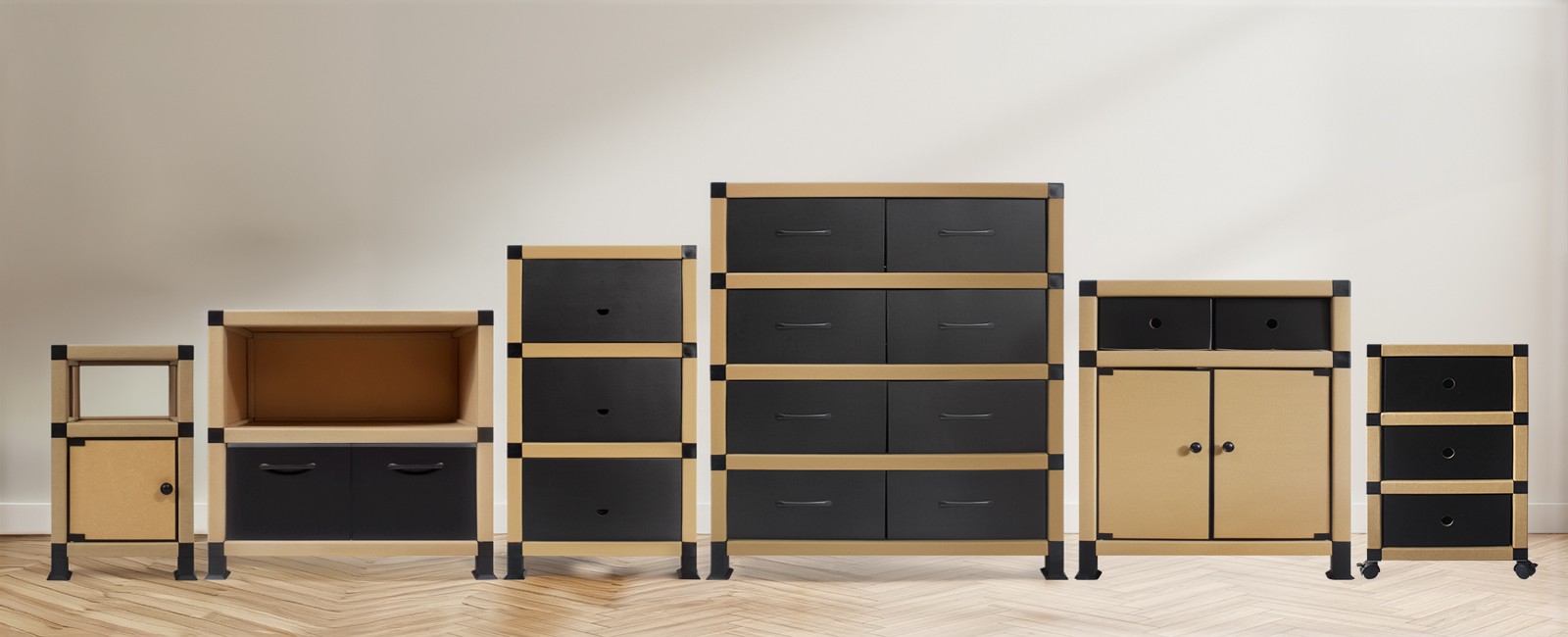
The catalog covers eight categories: bedside tables and nightstands, bedroom wardrobes and closets, sofa side tables, living room cabinets, home organizers and mobile storage units, bookcases and bookshelves, children's desks and seating, and pet houses. Each category contains multiple models with different dimensions, configurations, and storage features.
The manufacturer states that its furniture weighs approximately 20 to 30 percent as much as comparable traditional furniture. This weight reduction makes the products easier to carry, reposition, and ship, and it also means lower freight costs per unit for export orders.
Yes. The connector system is designed so that paper tubes slot into multi-prong PP connectors by hand. No screwdrivers, hammers, or Allen keys are needed. Most products can be assembled in under five minutes following the included step-by-step instructions.
Buyers can visit the company's website to browse the product catalog, then contact the sales team by email or phone to discuss quantities, customization, pricing, and shipping terms. The sales team guides buyers through the ordering process from sample request to production to shipment.
The manufacturer recommends controlling indoor humidity, keeping the furniture away from moisture at floor level, respecting the published load limits for each model, repairing damaged surface coatings promptly, and retightening or repairing loose joints when needed. Following these care guidelines helps maximize the service life of the product.
The questions buyers ask about a wholesale cardboard furniture exporter tend to circle around the same themes: Is it strong enough? Will it survive shipping? Can I make it my own? Is it truly green? The answers from MINHOU UNIMAX are grounded in a product system that has been refined since 2009, using patented connectors, treated kraft paper tubes, and a flat-pack format that keeps export costs competitive. For buyers who want to verify the claims before committing, the path is straightforward: request a sample, test the load capacity yourself, review the BSCI and FSC certificates, and arrange a factory audit if your order volume justifies it. The right way to evaluate any supplier is to ask these questions directly and judge how openly and specifically they respond.
