
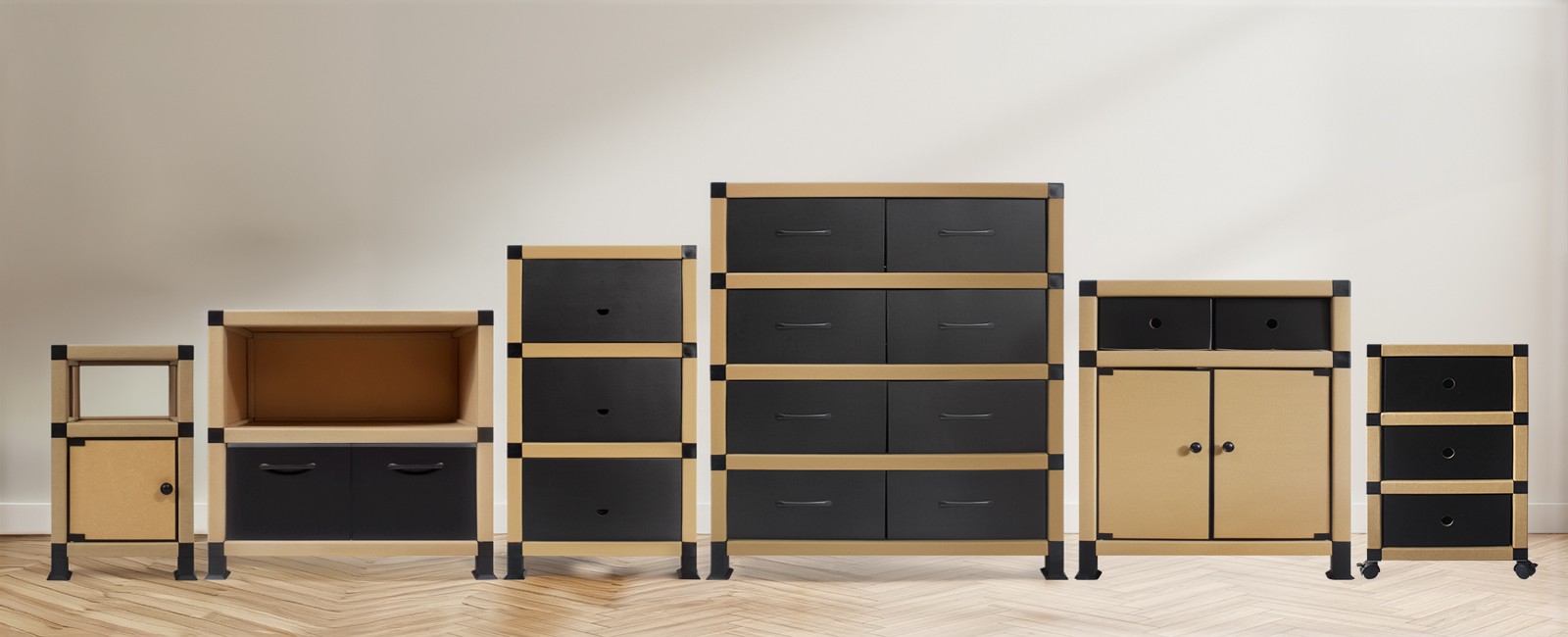
A flat pack wardrobe for export is a storage cabinet designed to be broken down into flat, stackable components at the factory, packed into corrugated cartons, loaded into shipping containers, and reassembled at the destination — all without screws, glue, or specialized tools.
The concept has reshaped how furniture moves across borders. Instead of shipping bulky assembled units that waste container space, manufacturers send compact packages that maximize every cubic meter of freight. For companies like MINHOU UNIMAX, the flat pack model goes a step further: rather than relying on cam locks, metal bolts, or wooden dowels, these wardrobes use high-strength paper tubes, reinforced paper panels, and multi-prong plastic connectors that snap together by hand. The result is a wardrobe that ships flat, weighs a fraction of a traditional unit, and assembles in minutes.
Every flat pack wardrobe for export from UNIMAX is built from three structural elements. Understanding how these parts interact is the key to understanding why the system works.
High-strength paper tubes. These form the vertical posts and horizontal rails of the wardrobe frame. Made from tightly wound kraft paper, they provide the load-bearing skeleton. Their cylindrical shape distributes weight along the entire length rather than concentrating it at joints, which is why a paper-tube wardrobe can support real loads despite its low mass.
Reinforced paper panels. These are the shelves, sides, backs, and doors. The panels go through a treatment process that gives them water resistance and surface durability. They are cut to precise dimensions at the factory so that every slot and notch aligns with the connector system.
Multi-prong PP connectors. These polypropylene joints are the backbone of the entire system. A 3-way connector joins three tubes at a corner; a 4-way connector creates a cross-junction. Each connector has multiple prongs that slide into the ends of paper tubes, gripping them through friction and geometric interlock. No tools are needed — the tubes push in by hand and hold firm under load.
Once a wardrobe passes quality inspection, it is broken down into its component parts for packing. The process is straightforward but controlled:
A wardrobe that stands 160 cm tall when assembled — such as the UM240130 model, measuring 77 × 65 × H160 cm — packs into a carton a fraction of that height. The flat-pack method protects the structure during transit and reduces the shipping volume dramatically. This is what makes the model viable for export: the wardrobe arrives at its destination as a compact, manageable package rather than a bulky, damage-prone unit.
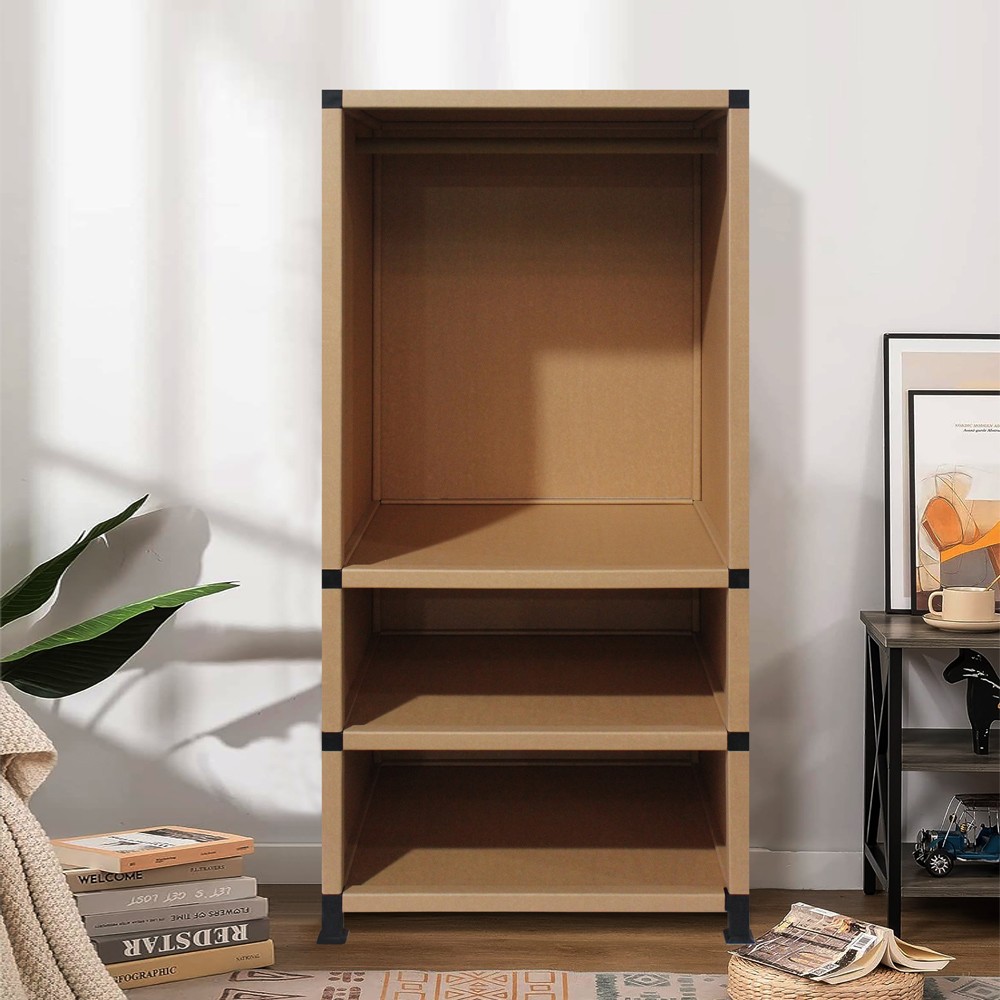
The UM240130 paper wardrobe stands 160 cm tall when assembled but ships flat in a compact carton.
The economics of flat pack furniture come down to one metric: cubic volume.
Ocean and air freight are priced by the greater of weight or volume. An assembled wardrobe is mostly empty air inside a container — the interior space of the cabinet ships at the same freight rate as the panels themselves. Flat packing eliminates that wasted volume.
For a 40-foot high-cube container, the difference is significant. Assembled wardrobes might yield 30 to 40 units per container. Flat-packed wardrobes can push that number several times higher, depending on the model and carton arrangement. The freight cost per unit drops accordingly, which is why flat pack has become the default for export-oriented furniture manufacturers.
Beyond the container, flat pack cartons are easier to handle at every stage of the supply chain:
This is where the UNIMAX system differs most from conventional knock-down furniture. Traditional flat pack wardrobes require an Allen key, a screwdriver, 30 to 90 minutes, and a measure of patience. The connector-based system removes all of that.
The assembly process works as follows:
The process takes roughly 10 to 15 minutes for a single wardrobe. Because there are no screws to strip, no cam locks to misalign, and no glue to dry, the assembly is repeatable: the wardrobe can be taken apart and rebuilt when a tenant moves out, a room is reconfigured, or the unit needs to be transported to a new location.
The foldable paper wardrobe is made from high-strength kraft paper that receives a special surface treatment for water and stain resistance. According to the company's product claims, its furniture weighs approximately 20 to 30 percent as much as traditional furniture made from wood or metal.
Despite the low weight, the structural design is built for real use. UNIMAX states that selected structures can support an adult weighing up to 80 kg, and the wardrobe models are designed for daily bedroom storage. The materials are recyclable and biodegradable, which aligns with the growing demand for sustainable furniture in rental, student housing, and temporary living markets.
UNIMAX has been a member of BSCI and FSC for years, and its production includes quality control from material selection through precision cutting and modular assembly. Test reports cover formaldehyde, load capacity, and other compliance parameters.
The flat pack wardrobe model is not designed to replace solid wood heirloom furniture. It is built for situations where portability, cost efficiency, and flexibility matter more than permanence:

The UM24061A paper bedroom closet — a compact, lightweight wardrobe designed for rental homes and flexible interiors.
For buyers sourcing flat pack wardrobes for export, several checks should be completed before a shipment leaves the factory:
These steps catch problems that a surface inspection of flat panels would miss. A wardrobe that looks fine in pieces can still fail if a connector is deformed or a panel slot is cut to the wrong depth. The assembly test is the single most effective check — it reveals hardware mismatches, instruction errors, and tolerance issues that no visual inspection can detect.
Paper-based flat pack wardrobes typically have a service life of 1 to 5 years, depending on materials, construction, use, and environment. Under suitable conditions — controlled indoor humidity, protection from floor-level moisture, and adherence to published load limits — the service life can exceed five years.
UNIMAX recommends keeping the furniture away from damp floors, repairing any damaged surface coatings promptly, and retightening or repairing loose joints when needed. These practices extend the usable life of the wardrobe and maintain its structural performance over time. The products are best suited to light-use, storage, decorative, transitional, and flexible-space applications rather than permanent heavy-load core furniture.
A flat pack wardrobe for export works by turning a full-sized storage unit into a set of flat, lightweight components that ship efficiently and assemble without tools. The structural system — paper tubes, reinforced panels, and multi-prong connectors — replaces the screws and cam locks of conventional flat pack furniture with a simpler, repeatable, and more sustainable design. For importers, distributors, and project buyers, this means lower freight costs, easier handling, and a product that serves the growing market for flexible, eco-friendly furniture.
The model is not a compromise. It is a deliberate engineering choice that trades permanent joinery for portability, cost efficiency, and environmental responsibility — and for the export market, that trade-off pays off on every container.
