
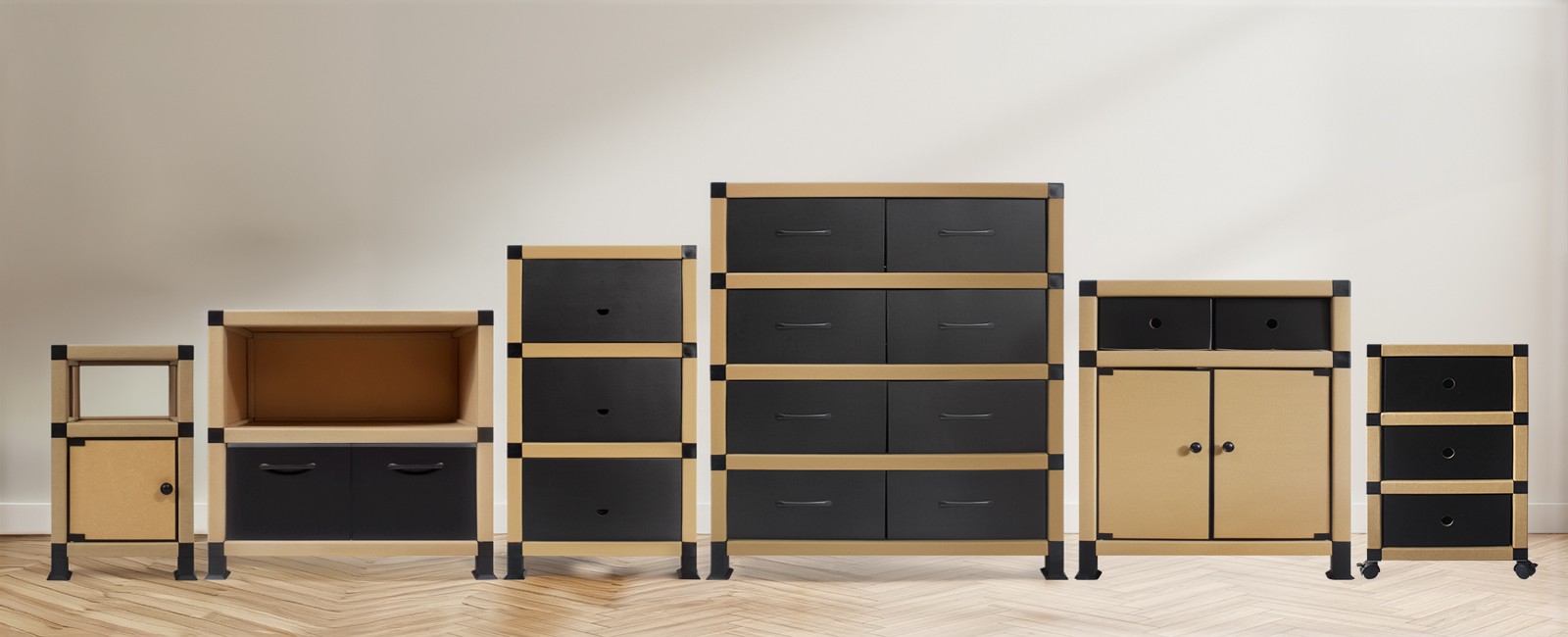
Anyone who has moved house knows the dread of wrestling a heavy wooden dresser down a narrow staircase or trying to fit a bulky wardrobe through a tight doorway. Conventional furniture, while sturdy, turns every relocation into an exhausting, expensive, and sometimes damaging ordeal. Lightweight moving furniture changes that equation entirely. Built from advanced materials like high-strength paper tubes and reinforced panels, this new category of lightweight furniture offers a distinctly different approach to furnishing a home, one designed for people who move, reorganize, and adapt their living spaces regularly.
Lightweight moving furniture refers to pieces engineered specifically for portability, easy assembly, and repeated disassembly without structural degradation. Unlike conventional furniture made from solid wood, particleboard, or metal, these pieces use materials such as high-strength kraft paper tubes, reinforced paper panels, and multi-prong polypropylene connectors. The result is furniture that weighs roughly 20 to 30 percent of what a traditional equivalent weighs, yet still supports meaningful loads. A well-constructed paper bookshelf, for instance, can carry up to 50 kg of books, while certain structures can support an adult weighing up to 80 kg.
The core difference lies in the engineering philosophy. Conventional furniture is built to stay in one place. Lightweight moving furniture is built to travel with you.
The most obvious advantage is weight. A standard wooden nightstand can weigh 15 to 25 kg. A paper-based nightstand of similar dimensions weighs a fraction of that, often light enough to carry with one hand. This matters enormously when you are moving between apartments, especially in buildings without elevators. One person can load, transport, and unload an entire room's worth of furniture without hiring professional movers or risking injury.
Reduced weight also means reduced physical strain on your body and your home. No scratched hardwood floors from dragging heavy pieces, no dented doorframes from forcing a bulky cabinet through a gap that is half an inch too narrow.
Conventional furniture typically requires screwdrivers, Allen wrenches, and an hour or more of careful work to assemble. Disassembly is often even harder, as screws strip, cam locks break, and instructions have long since been lost. Tool-free assembly furniture eliminates this problem entirely. Using patented multi-prong connector systems, the pieces snap together by hand in minutes and come apart just as easily when it is time to move.
This tool-free approach means you can disassemble a bedside table, pack it flat, move it across town, and reassemble it in your new bedroom, all without searching for a single screwdriver. The connectors are designed for repeated assembly and disassembly, so the furniture does not weaken over multiple moves.
When conventional furniture is disassembled, it still produces awkward, bulky components. Lightweight moving furniture, by contrast, is designed from the ground up for flat-pack shipping. Paper tubes, reinforced panels, and connectors pack separately into compact cartons that take up minimal space in a car trunk or moving van.
This flat-pack design serves two purposes. First, it reduces shipping volume dramatically, which lowers transportation costs, particularly important for export and long-distance moves. Second, it protects the structural components during transit because each part is individually packed rather than bearing the stress of being moved as a single rigid unit.
Conventional furniture made from particleboard and MDF often contains formaldehyde-based adhesives and ends up in landfills when damaged or unwanted. Lightweight paper-based furniture takes a fundamentally different approach. The materials are recyclable, renewable, and require significantly less energy to manufacture than wood or metal furniture. Companies like MINHOU UNIMAX, which has been a member of BSCI and FSC for years, use kraft paper that has been specially treated for water and stain resistance, extending the usable life of the furniture while maintaining full recyclability.
When a piece of paper furniture eventually reaches the end of its service life, it can be recycled rather than discarded. This stands in stark contrast to conventional furniture, which is difficult to recycle due to its mixed materials, metal hardware, and chemical treatments.
The true cost of conventional furniture is not just the purchase price. It includes mover fees, potential damage repairs, replacement of stripped or broken hardware, and sometimes the cost of entirely new furniture when a piece cannot survive another disassembly. Lightweight moving furniture reduces all of these secondary costs. Because one person can move it, because it packs flat into a personal vehicle, and because its connectors are designed for repeated use, the total cost of ownership over multiple moves is significantly lower.
Every new apartment brings a different layout. A wardrobe that fit perfectly in one bedroom may be too tall for the next. A bookcase that worked against one wall may not work against another. Lightweight modular furniture adapts to these changes. Pieces can be reconfigured, moved between rooms, or repurposed entirely. A bedside table can become a sofa side table. A storage cabinet can move from the living room to a home office. The low weight and tool-free assembly make this kind of flexibility practical rather than theoretical.
| Feature | Conventional Furniture | Lightweight Moving Furniture |
|---|---|---|
| Typical weight | 15 to 200 kg depending on piece | Roughly 20 to 30 percent of conventional weight |
| Assembly method | Screws, tools, 1 to 3 hours | Tool-free connectors, 10 to 30 minutes |
| Disassembly for moving | Difficult, hardware often damaged | Easy, connectors designed for repeated use |
| Transport | Bulky, often requires moving truck | Flat-pack, fits in a personal vehicle |
| Material sustainability | Mixed materials, hard to recycle | Recyclable paper-based materials |
| Movers needed | Often 2 or more people | Usually 1 person is sufficient |
| Damage risk during moves | High, scratches and dents common | Low, components packed separately |
