
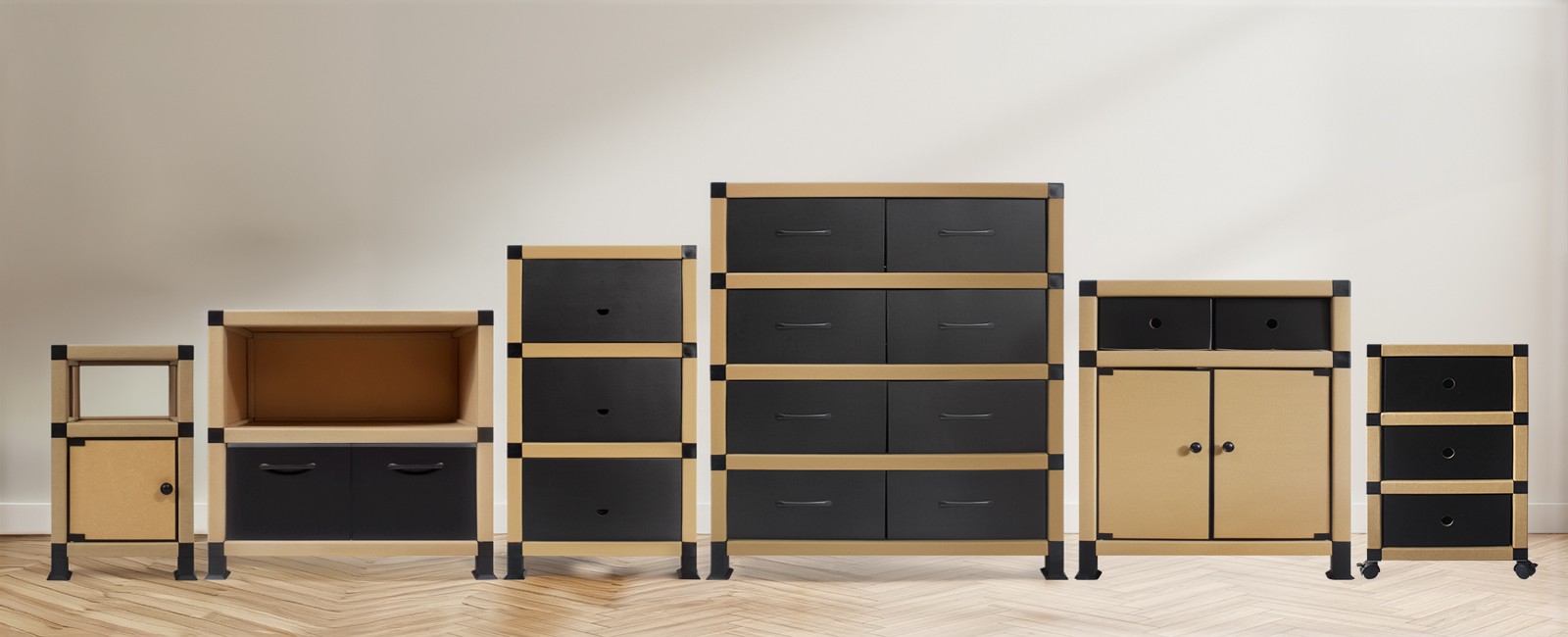
Retailers today face a constant tension between creating visually compelling store environments and keeping operational costs under control. Conventional fixtures built from wood, MDF, or metal have long been the default choice, but they come with hidden costs: heavy shipping weight, professional installation requirements, and limited reconfigurability. Engineered cardboard furniture for retail display offers a fundamentally different approach, combining structural strength with portability, sustainability, and cost efficiency. This article examines the concrete advantages that high-strength paper-based furniture holds over conventional materials in retail display scenarios.
A common misconception equates cardboard furniture with the thin, single-use corrugated POP displays used for short promotional bursts. Those temporary stands typically last weeks and struggle with heavy loads. Engineered cardboard furniture is a different category entirely. Manufacturers like MINHOU UNIMAX use high-strength kraft paper tubes, reinforced paper panels, and patented multi-prong polypropylene connectors to build modular pieces that can support meaningful weight, survive repeated assembly cycles, and serve for years rather than weeks.
This distinction matters for retail operators. When you choose structural paper-based furniture over disposable display stands, you gain the sustainability benefits of paper without sacrificing the load-bearing performance that real merchandise requires.
Weight is the single most visible difference. Conventional display furniture made from MDF or solid wood can be cumbersome enough to require two or more people, dollies, or even forklifts to reposition. A comparable cardboard piece typically weighs only 20 to 30 percent as much as its traditional counterpart while still carrying significant loads. For example, engineered paper bookshelves can support up to 50 kg of total load, and selected structural pieces are rated to hold an adult weighing up to 80 kg.
For retail staff, this means a single employee can reposition an entire display unit during a floor reset, a seasonal remerchandising, or a pop-up event setup. The labor savings compound quickly across multi-location rollouts.
Conventional furniture almost always requires tools. Wood and MDF units demand screwdrivers, drills, Allen wrenches, and sometimes professional installation teams. Metal fixtures need wrenches, bolts, and at least two people to hold components in place. The process is time-consuming and error-prone.
Engineered cardboard furniture uses interlocking paper tubes, reinforced panels, and multi-prong connectors that snap together by hand. No tools, no adhesives, no specialized skills. A store employee can assemble a complete display unit in minutes, not hours. When a campaign ends or a layout changes, the same unit disassembles just as quickly for storage or redeployment at another location. This tool-free assembly is particularly valuable for pop-up store display furniture, where setup speed directly translates to revenue-generating hours.
Shipping conventional furniture is expensive. Bulky, pre-assembled wood or metal units consume disproportionate warehouse and truck space, and their weight drives freight charges higher. Damaged corners and scratched surfaces during transit are common, adding replacement costs.
Cardboard furniture ships flat-packed. Paper tubes, panels, and connectors are disassembled and packed separately in compact cartons. This reduces shipping volume dramatically, which is especially significant for international delivery or multi-store deployments. A retailer outfitting ten locations can ship the entire display program in a fraction of the space that conventional fixtures would require. Lower shipping weight also means a lower carbon footprint per unit delivered.
Retail environments change. Seasonal campaigns demand new traffic flows. Product launches need dedicated feature zones. Pop-up shops appear and disappear within weeks. Conventional furniture resists this kind of agility because moving it is labor-intensive and risky.
Modular cardboard furniture thrives on change. Units can be disassembled, reconfigured into new shapes, and reassembled in a different part of the store within the same afternoon. A cardboard storage unit used as a living-room display fixture this month can become a back-to-school organizer display next month. The connector-based construction allows repeated assembly and disassembly without degrading structural integrity, giving retailers the flexibility to experiment with layouts at minimal cost.
Consumers increasingly expect the brands they shop with to demonstrate environmental responsibility. Conventional retail furniture made from MDF, particleboard, or metal carries a heavy manufacturing footprint. MDF off-gasses formaldehyde. Metal production consumes large amounts of energy. When these fixtures reach end of life, they are difficult to recycle and often end up in landfills.
Cardboard furniture tells a cleaner story. It is made from recyclable kraft paper, requires less energy to manufacture than conventional materials, and can be recycled at end of life. Manufacturers like MINHOU UNIMAX hold BSCI and FSC memberships, and their products undergo testing for formaldehyde, heavy metals, and phthalates. For retailers, this translates into a visible sustainability narrative that resonates with eco-conscious shoppers. A display made from paper-based materials is itself a marketing message.
A frequent concern with paper-based furniture is moisture vulnerability. While standard corrugated cardboard degrades in humid environments, engineered paper furniture addresses this through surface treatment. High-strength kraft paper receives water-resistant and stain-resistant coatings that protect against the spills, condensation, and humidity fluctuations common in retail settings.
Retailers should still follow basic care guidelines: keep furniture away from standing water at floor level, control indoor humidity, and repair damaged surface coatings promptly. With proper care, paper furniture typically serves one to five years, and service life can exceed five years under suitable conditions. This durability range is well-suited for retail display cycles, where fixtures are often refreshed seasonally or annually.
When comparing cardboard furniture to conventional fixtures, the cost advantage extends well beyond the purchase price. The total cost of ownership breaks down across several stages:
For multi-location retailers, trade show exhibitors, and pop-up operators, these savings multiply across every store, every event, and every campaign cycle.
Conventional furniture offers limited customization without significant additional cost. Wood can be painted or stained, but changing finishes means downtime and labor. Metal fixtures come in standard colors and configurations.
Cardboard furniture is inherently more adaptable. Paper surfaces accept a range of finishes and colors, and the modular connector system allows different configurations from the same components. A retailer can order units in white for a clean minimalist aesthetic, or choose colored finishes that match seasonal campaigns. Because the underlying structure is modular, the same set of components can be reconfigured into different shapes as merchandising needs evolve.
The advantages of cardboard furniture translate directly into specific retail use cases. Consider how different product types from the MINHOU UNIMAX catalog serve distinct display needs:
Bookcases and shelving: A five-tier paper bookcase standing 176 cm tall uses vertical space efficiently without requiring a large footprint. Retailers can display books, packaged goods, or decorative items while occupying minimal floor area. The unit supports up to 50 kg of total load, making it practical for real merchandise, not just lightweight props.
Living room cabinets: Paper storage cabinets with doors and open shelves combine enclosed storage for backstock with visible display space. This dual-function design is ideal for retailers who need to keep extra inventory accessible without cluttering the sales floor.
Modular organizers: Six-cube and nine-cube paper organizers provide compartmentalized display for small products like accessories, packaged foods, or cosmetics. Their vertical design maximizes display capacity per square meter, which is critical in high-rent retail environments.
Side tables and end tables: Compact paper side tables work as accent display surfaces for featured products near checkout areas or in window displays. Their lightweight construction means staff can reposition them throughout the day to test different traffic-flow strategies.
An honest comparison acknowledges that cardboard furniture is not the universal answer. Conventional wood or metal fixtures remain preferable in certain scenarios: permanent flagship installations where decades-long durability is the priority, outdoor retail environments with direct weather exposure, or high-traffic locations where fixtures experience constant impact from shopping carts and equipment.
The strongest retail strategies often combine both approaches. Permanent shelving provides structural backbone for core inventory, while cardboard furniture handles seasonal campaigns, pop-up activations, trade show booths, and flexible display zones where agility and cost control matter most.
The advantages of cardboard furniture for retail display over conventional furniture are clear when you look at the full picture. Lower weight reduces shipping and handling costs. Tool-free assembly cuts labor time and eliminates the need for specialized installers. Flat-pack shipping saves warehouse space and freight charges. Modular reconfigurability lets retailers adapt floor plans quickly. Sustainability credentials align with consumer expectations and corporate ESG goals. And engineered paper construction delivers load-bearing performance that disposable POP stands simply cannot match.
For retailers managing seasonal campaigns, multi-location rollouts, pop-up shops, or trade show programs, cardboard furniture is not just a cheaper alternative. It is a strategically superior choice that combines operational efficiency, environmental responsibility, and display flexibility in a way that conventional wood and metal fixtures cannot match.
