
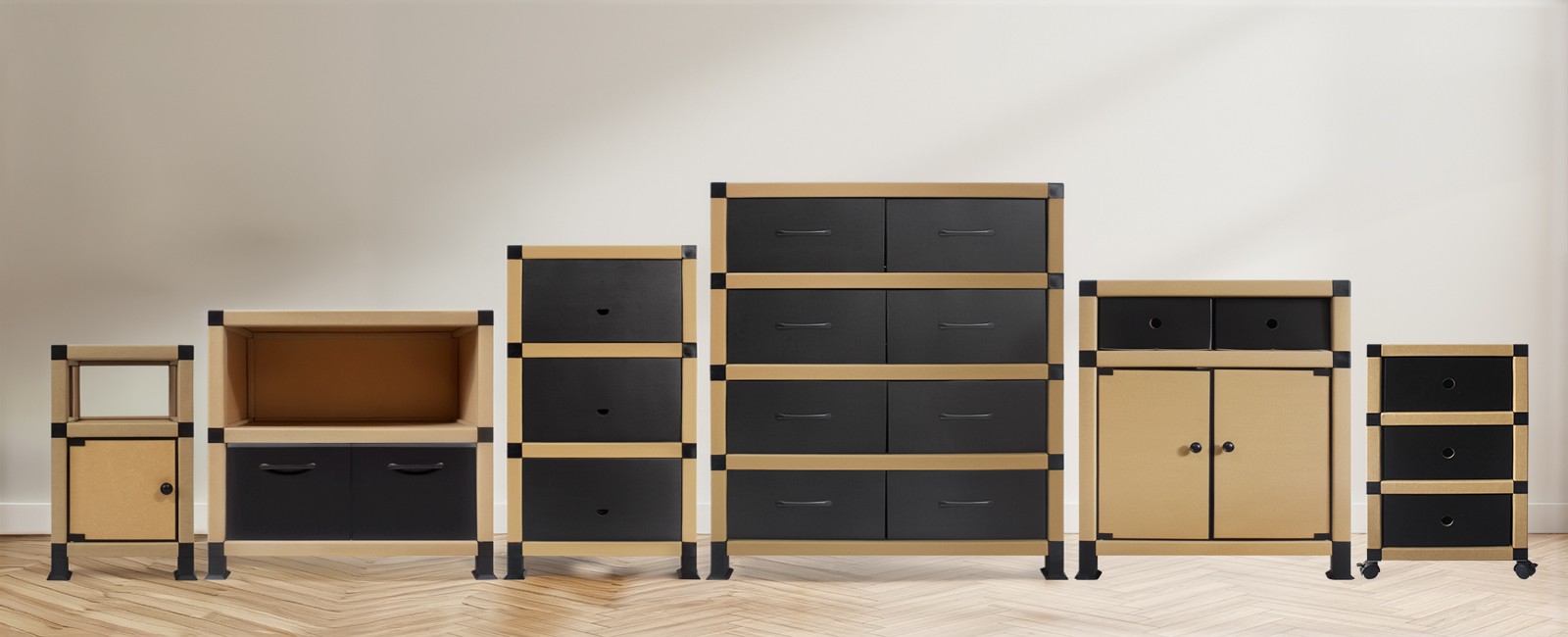
As more households and businesses shift toward sustainable living, a question naturally arises: can a lightweight, recyclable 9-cube cardboard storage shelf truly take the place of traditional wood, particleboard, or plastic storage furniture? The answer is more nuanced than a simple yes or no — and it depends heavily on how you use it, where you place it, and what you expect from your furniture.
At first glance, the word "cardboard" might bring to mind flimsy shipping boxes. However, modern eco-friendly furniture made from engineered paper materials is an entirely different category. Companies like MINHOU UNIMAX construct their 9-cube storage shelves using high-strength paper tubes, reinforced paper panels, and multi-prong polypropylene (PP) connectors. These components work together to distribute weight evenly across the structure, creating a surprisingly robust unit that can hold books, decorative items, clothing, toys, and household supplies across nine individual compartments.
Unlike traditional shelving that relies on screws, nails, or glue, these shelves use a patented connector system that allows tool-free assembly. The entire unit can be put together in roughly 10 to 15 minutes without a single tool — and just as easily disassembled when it is time to move or reconfigure your space.
| Feature | 9-Cube Cardboard Storage Shelf | Traditional Particleboard Shelf | Solid Wood Shelf |
|---|---|---|---|
| Weight | Extremely lightweight (approx. 5–8 kg), one person can carry easily | Heavy (approx. 20–35 kg), often requires two people to move | Very heavy (30–60 kg), difficult to relocate |
| Assembly | Tool-free, 10–15 minutes, intuitive snap-together design | Requires screwdriver or drill, 1–2 hours, complex instructions | Often pre-assembled or requires professional installation |
| Portability | Excellent — easy to move, disassemble, and transport in flat pack furniture form | Poor — difficult to disassemble; often damaged during moves | Very poor — heavy and cumbersome; rarely survives multiple moves intact |
| Eco-Friendliness | Made from recyclable and biodegradable materials; low carbon footprint | Contains glues and resins (often formaldehyde-based); hard to recycle | Contributes to deforestation; heavy transport emissions |
| Load Capacity | Engineered to support distributed loads — up to approximately 50 kg total across shelves | Moderate — can sag over time if overloaded | High — structurally strong but depends on wood type and construction |
| Moisture Resistance | Water-resistant surface treatment available; best used in dry indoor environments | Vulnerable — swells and disintegrates with prolonged moisture exposure | Moderate — can warp or develop mold if not sealed and maintained |
| Customization | Highly customizable — multiple colors, sizes, and configurations available | Fixed design — limited color and size options | Fixed or limited — custom woodwork is expensive and time-consuming |
| Cost | Budget-friendly — significantly less expensive than solid wood alternatives | Moderate — mid-range pricing | Expensive — high material and labor costs |
| Lifespan | 1–5 years under normal conditions; can exceed 5 years with proper care | 3–8 years, depending on quality and usage | 10+ years with proper maintenance |
For renters, students, frequent movers, and anyone who values flexibility, a cardboard storage shelf offers clear advantages that traditional furniture simply cannot match.
If you move every year or two, heavy wooden furniture becomes a logistical burden. A 9-cube cardboard shelf can be disassembled in minutes, packed flat, and carried to your next home without hiring movers or renting a truck. It leaves no wall damage, requires no anchoring, and imposes no restrictions on your security deposit.
Dorm rooms are notoriously small and transient. A lightweight, modular storage unit that assembles without tools is ideal for organizing textbooks, stationery, snacks, and personal items. At the end of the semester, it can be collapsed and stored or recycled — no need to wrestle a heavy bookshelf down three flights of stairs.
The nine individual cubes provide categorized storage for files, craft supplies, electronics, and decorative objects. The open design keeps everything visible and accessible, while the compact footprint saves floor space. Because the shelf is so light, you can easily reconfigure your office layout whenever inspiration strikes.
Parents appreciate furniture that is safe, lightweight, and free of harmful chemicals. MINHOU UNIMAX's cardboard furniture uses recyclable kraft paper treated with water-resistant coatings, and the construction avoids formaldehyde-based glues commonly found in particleboard. The rounded edges and light weight also reduce the risk of injury if a child bumps into or knocks over the unit.
For businesses that need temporary display shelving at trade shows or seasonal pop-up stores, cardboard furniture offers a compelling combination of low cost, easy transport, and customizable appearance. The shelves can be branded, set up in minutes, and recycled after the event — eliminating storage and disposal headaches.
Honesty matters. A cardboard shelf is not a one-to-one replacement for a solid oak bookcase in every scenario. Knowing its boundaries helps you make the right choice.
Although MINHOU UNIMAX applies water-resistant surface treatments to its paper furniture, prolonged exposure to high humidity or direct water contact can compromise structural integrity. These shelves are best suited for dry, climate-controlled indoor environments. Avoid placing them in bathrooms, damp basements, or near open windows during rainy seasons.
While the engineered paper tube and connector system can support impressive loads — selected UNIMAX structures can bear up to 80 kg of distributed weight, and a bookshelf can carry a total load of approximately 50 kg — these are not designed for heavy appliances, large collections of hardcover encyclopedias, or industrial storage. Distribute weight evenly across compartments and respect the manufacturer's published limits.
Paper furniture typically has a service life of 1 to 5 years, depending on materials, construction quality, usage patterns, and environmental conditions. Under suitable conditions with proper care, it may exceed five years. This makes it an excellent choice for transitional, light-use, and flexible-space applications — but not for heirloom furniture you plan to pass down through generations.
Like all paper-based products, cardboard furniture is combustible. Keep shelves away from open flames, space heaters, and electrical outlets that may spark. This is a standard precaution that applies to wooden furniture as well, but it is worth noting explicitly.
Not all cardboard shelves are created equal. When evaluating options, pay attention to these key factors:
To maximize the lifespan of your cardboard storage shelf, follow these simple guidelines:
The answer is yes — in many situations, and for many people, it already has.
A 9-cube cardboard storage shelf can effectively replace traditional particleboard or wooden shelving for anyone who prioritizes sustainability, portability, affordability, and tool-free assembly. It is an ideal solution for renters, students, young professionals, families with children, and businesses needing temporary display units.
However, if your primary requirements are generational longevity, extreme load-bearing capacity, or use in humid environments, traditional solid wood or metal shelving remains the better choice. The key is matching the furniture to the lifestyle — and for the growing number of people living in flexible, mobile, and eco-conscious ways, a well-made cardboard storage shelf is not just a replacement, but an upgrade.
As manufacturing technology continues to advance, with innovations in nano-coatings, reinforced paper composites, and modular connector design, the gap between cardboard and traditional furniture narrows every year. What was once considered a novelty is now a legitimate, practical, and increasingly popular choice for modern home storage.
