
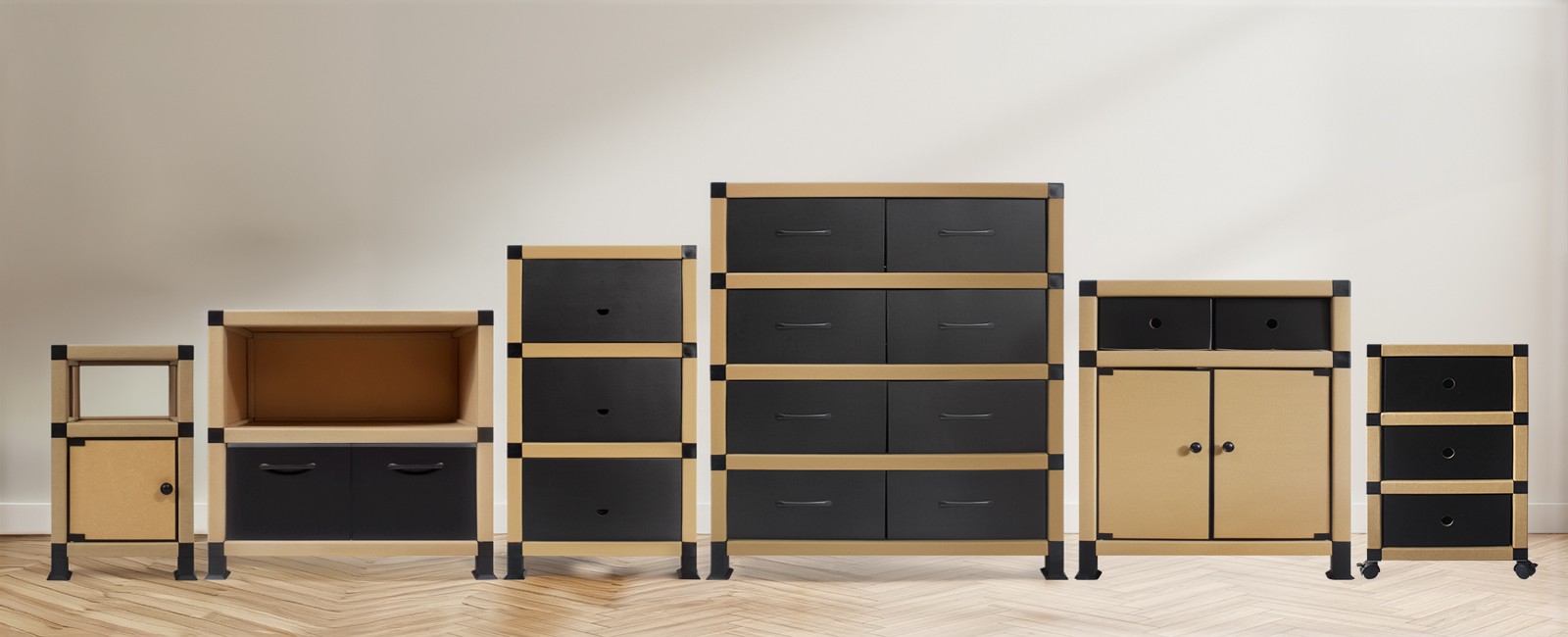
Why patented kraft paper furniture is quietly outperforming bamboo, reclaimed wood, and recycled plastic — and what it means for your home.
Walk into any eco-conscious furniture showroom today and you will likely find pieces crafted from reclaimed timber, rapidly renewable bamboo, or recycled ocean plastic. These materials have earned their place in the sustainability conversation. But they all share a quiet limitation: they are heavy, they require tools and hardware to assemble, and when they eventually wear out, recycling them is far from straightforward.
A new category is changing that conversation. Paper furniture — engineered not from flimsy cardboard boxes but from high-strength kraft paper tubes and patented structural connectors — is proving that sustainable design can be lighter, stronger, and more practical than anything that came before it.
Bamboo is a remarkable material — fast-growing, durable, and visually striking. But a solid bamboo dining table can weigh 40 kilograms or more. Moving it up three flights of stairs to a rental apartment is an ordeal. Reclaimed wood carries similar burdens: every piece is dense, difficult to disassemble, and often requires professional help to transport or rearrange.
Recycled plastic furniture solves the weight problem but introduces another: it does not biodegrade. After years of use, it still ends up in a landfill, just in a different form. The sustainability loop remains open.
Genuine sustainable furniture should solve problems, not create new ones. It should be light enough for one person to carry. It should go together without a single screwdriver. And when it has served its purpose, it should return to the recycling stream as cleanly as a newspaper.
Since 2009, Minhou Unimax has been refining a deceptively simple idea: take industrial-grade kraft paper, roll it into high-density tubes, and connect them using patented joint systems to create furniture that rivals traditional materials in strength while weighing only 20 to 30 percent as much.
The result is kraft paper furniture that turns every assumption about paper on its head. An adult weighing up to 80 kilograms can stand on a paper end table without causing deformation. A paper bookshelf can hold up to 50 kilograms of books, electronics, and decorative items with the stability of a wooden unit.
The secret is not in the paper alone — it is in the engineering. Patented double-groove three-way connectors and paper square tube joints distribute weight through mechanical optimization rather than brute material density. Less material, smarter structure, equal or greater strength.
The most common objection to paper furniture is also the most understandable: what happens when something spills? The answer, thanks to a specialized surface treatment, is surprisingly little.
Waterproof paper furniture from Minhou Unimax undergoes a technological coating process that delivers more than five minutes of water and stain resistance. In practical terms, that morning cup of coffee tipped over onto your bedside table is not a catastrophe — it is a ten-second cleanup with a damp cloth.
This is where paper furniture pulls ahead of untreated bamboo and raw reclaimed wood, both of which can absorb moisture, warp over time, and develop mold in humid environments. The coating does not compromise recyclability, either. When the furniture eventually reaches the end of its life cycle, the paper substrate remains fully recyclable.
Anyone who has spent an evening wrestling with an Allen wrench and a page of cryptic diagrams knows that assembly is the Achilles’ heel of flat-pack furniture. Minhou Unimax eliminates that friction entirely.
Using toolless assembly furniture design, every piece connects through a simple plug-in system. No screws, no glue, no hardware bag to lose behind the couch. A bookshelf goes from flat-pack to fully loaded in minutes, and it disassembles just as quickly when it is time to move.
This is not a minor convenience. For renters who relocate every year, for students furnishing dorm rooms, for event organizers who set up and tear down displays weekly — toolless assembly transforms furniture from a permanent commitment into a flexible, movable asset.
The modular nature of patented paper tube construction makes it uniquely suited to environments where flexibility matters as much as durability. Here is where it shines:
For anyone living in compact quarters, small space furniture that weighs a fraction of conventional pieces means rearranging a room is a one-person job, not a two-friend-and-a-truck job. A paper end table can serve as a nightstand, a plant stand, or a laptop desk — and move between those roles without breaking a sweat.
Pet owners get an unexpected bonus: a purpose-built paper cat house that is sturdy enough for daily feline antics, ventilated to reduce odor, and designed with a top shelf for food bowls. When it eventually wears out, it goes into the recycling bin — not a landfill.
Sustainability claims are easy to make. Proving them is harder. Minhou Unimax backs every piece with credentials that hold up to scrutiny:
These are not marketing badges. They are the reason architects, school procurement officers, and eco-conscious retailers can specify paper furniture with confidence.
The most compelling argument for paper furniture may be the simplest one: it closes the loop. A tree becomes kraft paper. Kraft paper becomes a bookshelf, a side table, a cat house. Years later, that same furniture becomes pulp again — ready to be reborn as something new.
No other furniture material offers this clean a cycle. Bamboo takes decades to decompose in a landfill. Reclaimed wood, once glued and screwed into a finished piece, is nearly impossible to separate for recycling. Recycled plastic, as the name suggests, is still plastic.
Paper furniture is not just a lighter, stronger, more practical alternative. It is the only mainstream furniture category where the end of the product’s life is as sustainable as its beginning.
Minhou Unimax has spent over a decade perfecting patented paper tube technology — furniture that is spill-proof, tool-free, lightweight, and fully recyclable. From bedroom storage to office tables to pet houses, every piece is engineered for real life and designed for a circular future.
Explore the full collection at fz-unimax.com and discover how kraft paper is quietly rewriting the rules of sustainable living.
