
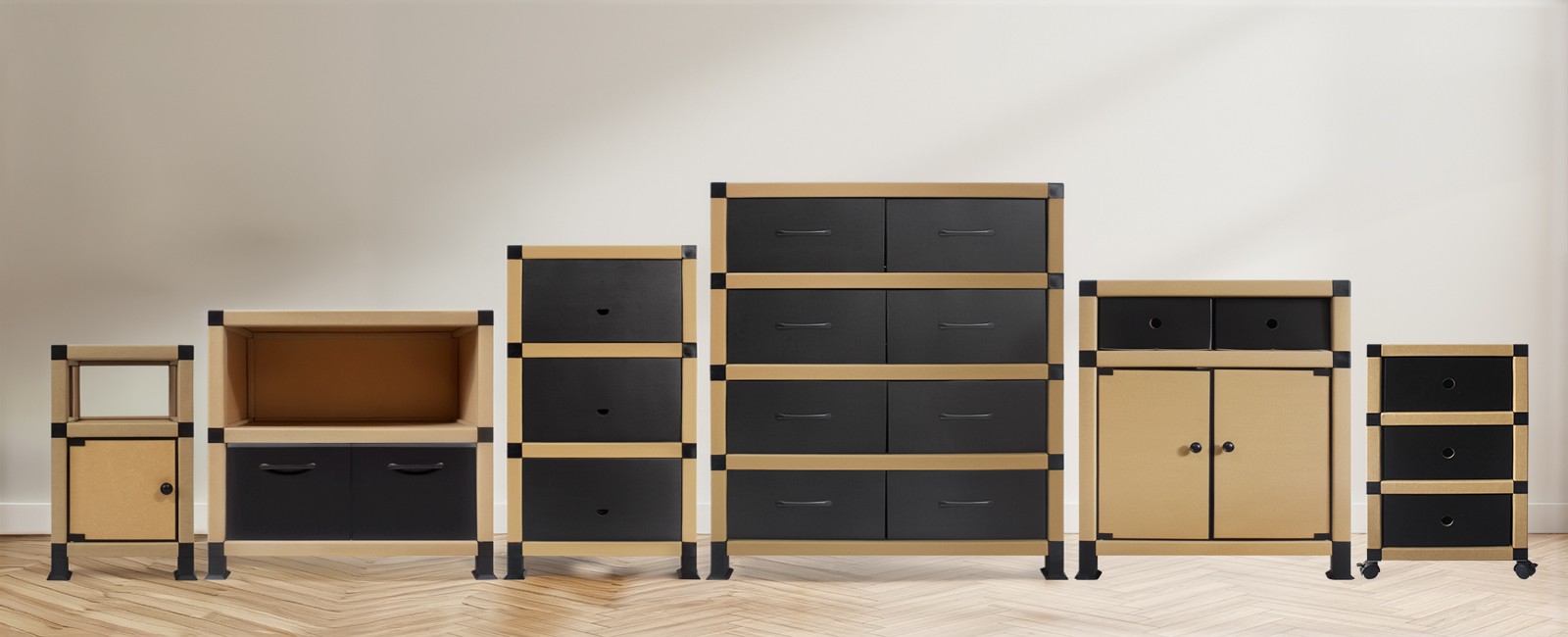
When most people think about shrinking their household carbon footprint, they picture LED bulbs, compost bins, and electric cars. Rarely does furniture come to mind — yet the chairs, tables, and shelves in your home carry a surprisingly heavy environmental cost. Conventional furniture relies on timber harvesting, metal mining, plastic injection molding, and long-distance shipping, all of which generate significant emissions before a single piece reaches your door. There is a quieter, lighter alternative gaining traction among environmentally conscious homeowners, renters, and businesses: furniture made from high-strength paper and cardboard. This article explores why low carbon footprint furniture is more than a trend — it is a practical shift that combines sustainability with everyday durability.
Traditional furniture materials each carry distinct environmental burdens that rarely appear on a price tag:
Once these materials are combined into a finished product, the item is shipped — often half-assembled in bulky packaging — to warehouses and retail stores worldwide. At the end of its life, most furniture ends up in landfills, where synthetic components persist for decades. The full lifecycle carbon cost of a single conventional wardrobe or bookshelf is far larger than its weight suggests.
Furniture built from engineered kraft paper tubes, reinforced paper panels, and multi-prong polypropylene connectors offers a fundamentally different material story. Paper is derived from renewable wood pulp, requires less energy to process than metal or plastic, and can be recycled multiple times before losing structural integrity.
MINHOU UNIMAX, a manufacturer based in Fuzhou, China, has been refining this approach since 2009. The company's patented paper-furniture structures use specially treated kraft paper that is water- and stain-resistant, combined with three-way and multi-prong connector systems designed to distribute load efficiently. The result is eco-friendly furniture that weighs roughly 20–30% as much as conventional pieces — meaning less raw material, less fuel for shipping, and less waste at end of life.
The company states that selected structures can support an adult weighing up to 80 kg and that a bookshelf can carry a total load of 50 kg. These figures reflect the brand's own testing and should be verified for the specific model before commercial or safety-critical use.
One of the most effective — yet overlooked — ways to cut furniture-related emissions is through packaging and logistics. Traditional furniture ships largely assembled or partially assembled, occupying significant volume relative to its usable size. This inefficiency means more trucks on the road and more containers on ships.
Flat pack furniture addresses this directly. MINHOU UNIMAX disassembles every product — paper tubes, panels, and connectors packed separately in compact cartons — before shipping. A bookshelf, wardrobe, or storage cabinet that stands 1.5 meters tall in your home arrives in a flat box a fraction of that size. More units fit per shipment, which translates directly into fewer transport miles and lower carbon output per piece delivered.
Conventional furniture assembly often requires power tools, metal fasteners, and sometimes professional installation. Every screw, bracket, and Allen wrench represents additional manufacturing and material inputs that add to the product's overall carbon footprint.
MINHOU UNIMAX's tool-free assembly furniture eliminates this overhead entirely. The patented connector system lets you slot paper tubes into multi-prong joints by hand — no drills, no screws, no glue. Pieces can be assembled, disassembled, and reassembled repeatedly without structural degradation, making the furniture ideal for people who move frequently, renters, students, and businesses that reconfigure spaces regularly.
Perhaps the most compelling environmental argument for paper furniture is what happens when a piece reaches the end of its useful life. Unlike plastic or composite furniture that lingers in landfills, paper-based furniture can be recycled through standard paper-waste streams or, if coated with biodegradable treatments, allowed to decompose naturally.
MINHOU UNIMAX designs its products as recyclable furniture from the ground up. The company has been a member of BSCI and FSC for years, and its products undergo testing for formaldehyde, load capacity, and harmful substances including POP/PCP, cadmium, and phthalates. This commitment to material transparency means buyers can make informed decisions about what they bring into their homes — and what happens to it afterward.
A common misconception about paper furniture is that it is fragile or purely decorative. MINHOU UNIMAX's engineering tells a different story. The surface treatment provides water and stain resistance, and the modular connector system allows repeated assembly without loosening. The product range spans eight categories, covering nearly every room in a home:
This breadth means a household can furnish an entire apartment — bedroom, living room, study, children's room, and even a cat's corner — with a consistent low-carbon material strategy rather than mixing materials that are difficult to separate and recycle.
While paper furniture suits a wide range of users, several groups benefit particularly from its combination of light weight, modular design, and recyclability:
If you are considering paper furniture as part of a lower-carbon lifestyle, here are a few practical suggestions to get the most from your investment:
Reducing your home's carbon footprint does not require sacrificing comfort, function, or design. Paper-based furniture demonstrates that renewable, lightweight, and recyclable materials can deliver genuine structural performance — from bedside tables that organize your essentials to wardrobes that anchor a bedroom. By choosing furniture engineered for lower material weight, efficient shipping, and end-of-life recyclability, you make a tangible contribution to reducing household emissions without upending your daily routine.
MINHOU UNIMAX has spent over a decade proving that kraft paper, precision engineering, and thoughtful design can produce furniture that is both environmentally responsible and practically durable. Explore the full product catalog and discover how low-carbon furniture can fit into your home, your lifestyle, and your values. For inquiries about OEM partnerships, wholesale orders, or custom designs, visit the contact page to speak with the team directly.
