
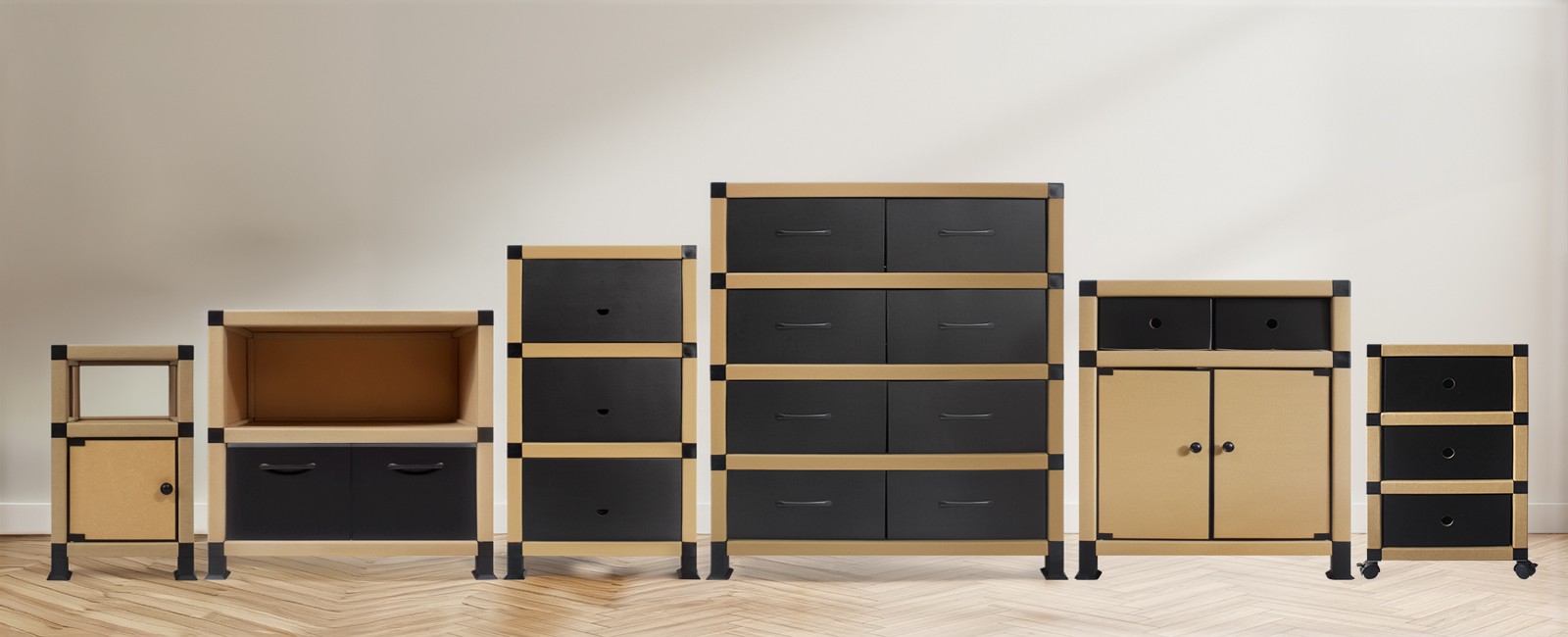
A cluttered closet is one of the most common frustrations in any home. Clothes pile up on the single shelf above the rod, shoes scatter across the floor, and seasonal items get stuffed into corners where they are impossible to find. A paper storage shelf organizer offers a practical answer to this problem by turning wasted vertical space into structured, category-based storage that you can actually maintain. Built from high-strength kraft paper tubes, reinforced paper panels, and multi-prong polypropylene connectors, these organizers combine the durability of engineered paper furniture with the lightweight, tool-free assembly that renters and apartment dwellers need. This article walks through exactly how a paper storage shelf organizer works, what it does for your closet, and how to choose and set up the right one for your space.
A paper storage shelf organizer is a freestanding shelving unit made from treated kraft paper materials. Unlike flat-pack particle board furniture that requires screws, Allen wrenches, and an hour of frustration, a paper storage shelf snaps together using interlocking paper tubes and multi-prong connectors that slot into place by hand. No tools are needed, and the entire unit can be disassembled and reassembled repeatedly without losing structural integrity.
The core structural components are threefold: high-strength paper tubes that form the vertical posts and horizontal supports, reinforced paper panels that serve as shelf surfaces, and polypropylene connectors with three-way or multi-prong designs that distribute weight across multiple contact points. The kraft paper used in these tubes receives a surface treatment for water and stain resistance, which helps the organizer hold up in the humidity-sensitive environment of a closet or bedroom.
Because the entire unit is made from paper-based materials, it weighs roughly 20 to 30 percent as much as a comparable piece of conventional furniture, according to the manufacturer. That weight difference matters in a closet context: you can place a paper storage shelf organizer on an existing closet shelf, inside a wardrobe, or against a closet wall without worrying about overloading the structure or the floor underneath.
Most closets have a significant gap between the top of hanging clothes and the ceiling or the shelf above. That dead air space does nothing while the closet floor overflows. A tall paper storage shelf, such as a unit standing 144 cm high, turns that unused vertical column into four or five usable shelf levels. Folded sweaters, storage boxes, handbags, and out-of-season clothing all move off the floor and onto dedicated shelves, instantly freeing up the lower portion of the closet for shoes and daily-wear items.
The biggest problem with a standard closet shelf is that it is a single flat surface with no dividers. Everything ends up in one pile, and finding a specific scarf or pair of gloves means digging through the entire stack. A cube-style recyclable home organizer solves this by dividing the storage area into separate compartments, each assigned to one category. A six-cube unit gives you six dedicated spaces; a nine-cube unit gives you nine. You always know which cube holds workout gear, which holds accessories, and which holds folded t-shirts, because each cube is a physical boundary that prevents items from migrating into neighboring zones.
Wooden and metal shelving units are heavy enough that once you position them, they stay put, because moving them means lifting and possibly disassembling. A paper storage shelf organizer is light enough to pick up and slide to a new spot in the closet whenever your storage needs change. If you reorganize your closet for summer and need the organizer in a different corner, you simply lift and move it. Some models even come with universal wheels, allowing you to roll the unit in and out of the closet without lifting anything at all.
The multi-prong connector system means that assembling a paper storage shelf takes minutes, not an hour. The tubes slot into the connectors, the panels drop into place, and the structure locks together through tension and geometric design rather than screws or glue. If you move apartments, the entire unit disassembles into flat components that pack into a carton for transport. This is especially valuable for renters, students in dormitories, and anyone who relocates frequently and needs furniture that travels well rather than ending up on the curb.
Open-shelf paper organizers keep everything in sight rather than hidden behind doors. When you can see your belongings, you are more likely to use them and less likely to forget what you own. This visibility also speeds up your morning routine: instead of opening a drawer and rummaging, you glance at the shelf, grab what you need, and move on. For items that you prefer to keep enclosed, such as delicates or seasonal accessories, a paper storage cabinet with doors combines open display shelving with a closed compartment, giving you both visibility and protection from dust.
When a wooden shelf reaches the end of its life, it goes to a landfill or requires specialized disposal. A paper storage shelf organizer, by contrast, is made from recyclable kraft paper and polypropylene connectors that can be separated and recycled through standard waste streams. For anyone who values reducing their household waste footprint, this is a meaningful advantage: the organizer serves its purpose for years and then returns to the recycling cycle rather than sitting in a landfill indefinitely.
Not every closet needs the same type of organizer. The right choice depends on the closet's size, what you store in it, and whether you need open access or enclosed storage. The table below compares the main types of paper storage organizers and where each one fits best:
| Organizer Type | Best For | Key Advantage in a Closet |
|---|---|---|
| Large storage shelf (5+ tiers) | Walk-in closets, wide reach-in closets | Maximum vertical storage in a slim footprint |
| 6-cube or 9-cube organizer | Category-based storage for accessories, folded clothes | Each cube acts as a natural divider between categories |
| Mobile organizer with wheels | Closets where you need to pull storage in and out | Rolls out for access, rolls back to save space |
| Cabinet with doors and open shelf | Mixing visible display with enclosed storage | Dust-free storage for delicates, open shelf for daily items |
| Paper wardrobe / closet | Bedrooms without a built-in closet | Freestanding hanging and shelf storage in one unit |
For example, a large paper storage shelf standing 144 cm tall with a depth of only 32.5 cm slides into a narrow closet alongside the hanging rod without eating into the space where your clothes hang. A six-cube organizer measuring 81 by 42 cm works well in a wider closet where you can dedicate one wall to shelf storage. If your bedroom has no built-in closet at all, a paper bedroom closet provides a freestanding wardrobe that combines a hanging section with shelf space in a single unit.
Getting your closet organized with a paper storage shelf is straightforward. Follow these steps to go from cluttered to structured in a single afternoon:
Take everything out of the closet and lay it on your bed or floor. This gives you a clear view of the space you are working with and forces every item to earn its way back in. While the closet is empty, wipe down the shelves and rod, and note the dimensions: floor-to-ceiling height, rod length, and shelf depth. These measurements determine which organizer size will fit.
Sort every item into three piles: keep, donate or sell, and relocate. The keep pile is for items you wear regularly and that belong in this closet. The donate pile is for items in good condition that you no longer use. The relocate pile is for things that ended up in the closet because they had nowhere else to go, such as extra bedding or holiday decorations, which should live in a different storage area. Be honest with yourself: if you have not worn something in the past year and it is not seasonal, it probably belongs in the donate pile. Decluttering before organizing frees up more space than any organizer product can create.
With the closet empty, divide the space into functional zones: the hanging zone for clothes on hangers, the shelf zone for folded items and accessories, the floor zone for shoes and bins, and the door zone for hooks or hanging pockets. Decide where the paper storage shelf organizer fits. In most closets, the best spot is along one side wall or at the back, where it adds vertical shelving without blocking the hanging rod.
Unpack the flat-pack components and assemble the organizer following the connector system. Slot the paper tubes into the multi-prong connectors, place the reinforced panels on the shelf supports, and build the unit tier by tier. The process requires no tools and typically takes a fraction of the time needed for conventional flat-pack furniture. If your model includes wheels, attach them last so you can roll the unit into position.
Assign each shelf or cube a single category and load items accordingly. Place daily-wear items on the most accessible shelves at eye and hand level. Reserve higher shelves for seasonal or rarely used items, and lower shelves or floor cubes for shoes and heavier bins. If you are using a cube organizer, label each cube with its category so everyone in the household knows where things belong. Loading by category rather than by convenience is what keeps the system intact over time.
Every few months, do a quick review: pull out items that have migrated to the wrong shelf, return them to their assigned cube, and remove anything that no longer belongs in the closet. This seasonal review takes a few minutes and prevents the gradual drift that turns an organized closet back into a pile. The lightweight nature of the paper organizer makes this easy, because you can shift or remove a shelf unit without heavy lifting if you need access to the back of the closet.
Paper furniture is designed for light-use, storage, and decorative applications, and with reasonable care it can last well. The manufacturer notes that paper furniture commonly has a service life of approximately one to five years depending on materials, construction, use, and environment, and that service life may exceed five years under suitable conditions. Here are the key care practices for a closet environment:
Beyond the practical benefits of weight and assembly, paper furniture brings a set of advantages that align with modern priorities around sustainability and flexible living:
Yes. The manufacturer states that selected structures can support an adult weighing up to 80 kg and that a bookshelf can carry a total load of 50 kg. For closet use, where the typical load consists of folded clothing, accessories, and storage boxes, this capacity is more than sufficient. The key is to distribute weight evenly across the shelves rather than loading one shelf with all your heaviest items.
The kraft paper used in these organizers receives a surface treatment for water and stain resistance, which helps it tolerate normal indoor humidity. However, paper furniture is not suited for wet environments. To keep your organizer in good condition, control indoor humidity, keep it away from direct moisture at floor level, and avoid placing it in areas prone to condensation. A moisture absorber in the closet can help if you live in a humid climate.
According to the manufacturer, paper furniture commonly has a service life of one to five years depending on materials, construction, use, and environment. Under suitable conditions, the service life may exceed five years. The organizer is best suited for light-use, storage, and decorative applications rather than as permanent heavy-load core furniture.
Yes. The tool-free connector system is designed for repeated assembly and disassembly. The tubes, panels, and connectors pack flat into cartons, which reduces shipping volume and protects the components during a move. This makes paper storage shelf organizers a good choice for renters, students, and anyone who relocates frequently.
Yes. The product range includes large storage shelves, six-cube and nine-cube organizers, mobile units with wheels, cabinets with doors and open shelves, and bedroom wardrobes. Sizes range from compact units measuring about 52 by 31 cm to large shelves measuring 141 by 32.5 cm. This variety means you can find an organizer that fits the specific dimensions of your closet, whether it is a narrow reach-in or a wide walk-in.
A paper storage shelf organizer makes your closet more organized by doing what a single flat shelf cannot: it divides space into manageable, category-based compartments, activates vertical space that would otherwise go unused, and provides a storage structure that is light enough to reposition whenever your needs change. The tool-free assembly, flat-pack portability, and recyclable materials make it particularly well suited for renters, students, and anyone who values sustainable home storage. By choosing the right organizer type for your closet layout and loading it by category, you can transform a chaotic closet into a structured, accessible space that stays organized for the long term.
