
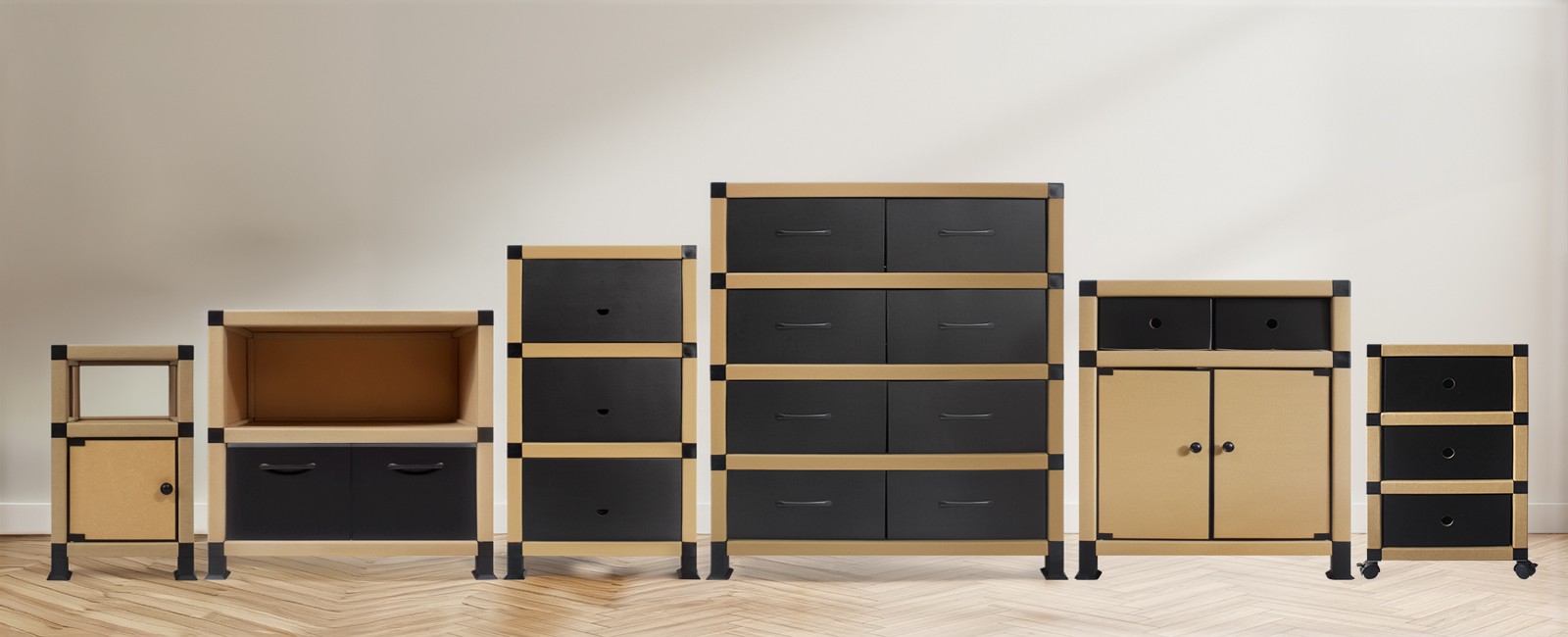
When most people hear the phrase "paper furniture," they picture a fragile cardboard box that would collapse under the weight of a coffee mug. That perception is outdated. Today's paper furniture is an engineered category of home furnishings built from high-strength kraft paper tubes, reinforced panels, and precision connectors — capable of supporting adult body weight, resisting everyday spills, and lasting for years. But with so many designs, materials, and construction methods on the market, understanding what types are available is the first step toward choosing the right pieces for your space.
Paper furniture is a broad term covering any functional household or office item — tables, chairs, shelves, cabinets, wardrobes, pet houses — whose primary structural material is engineered paper. Unlike disposable packaging, these products use layered cross-lamination, honeycomb cores, or high-density kraft tubes to achieve load-bearing performance that rivals conventional materials at a fraction of the weight.
The category has grown because it addresses three modern pressures simultaneously: environmental responsibility, frequent relocation, and shrinking living spaces. Manufacturers like MINHOU UNIMAX, based in Fuzhou, China, have been refining paper-furniture engineering since 2009, developing patented connector systems and surface treatments that make paper a serious structural material — not a novelty.
Before diving into specific product categories, it helps to understand the four primary construction methods that define how paper furniture is built. Each method produces different strength characteristics, weight capacities, and ideal use cases.
This is the construction method used by MINHOU UNIMAX and represents the most versatile approach to paper furniture. High-strength kraft paper is rolled into dense tubes that serve as vertical supports and horizontal beams. These tubes connect via patented multi-prong polypropylene (PP) connectors — typically three-way or four-way designs — that distribute weight evenly across the structure and allow for repeated assembly and disassembly without degrading the joints.
The result is furniture that weighs roughly 20–30% as much as traditional wood or metal equivalents, yet can support an adult weighing up to 80 kg on seating structures and carry up to 50 kg on a bookshelf. The connector-based design also means no tools are required — pieces simply slot and click together.
Honeycomb-core paper furniture uses hexagonal cell structures sandwiched between two flat kraft paper surfaces. The geometric pattern provides an exceptional strength-to-weight ratio, particularly under vertical compression. This method is common in shelving units, display stands, and some seating designs. While strong under evenly distributed loads, honeycomb panels can be vulnerable to concentrated side impacts, so they are best suited for stationary use rather than furniture that gets frequently moved.
Single-sheet or multi-layer corrugated fiberboard is folded into load-bearing shapes — often chairs, stools, or small tables — using tab-and-slot techniques without adhesives. These pieces are ultra-lightweight and inexpensive, making them popular for events, trade shows, and temporary installations. However, their service life is typically shorter (6–12 months) and they are more susceptible to moisture damage unless treated with a protective coating.
Multiple layers of kraft paper are bonded together with non-toxic resins to create panels with wood-like density and rigidity. This method produces the most durable paper furniture, capable of lasting three or more years indoors and supporting heavier loads. Laminated kraft panels are used for desks, bed frames, and reinforced shelving. The trade-off is higher cost and greater weight compared to tube-and-connector or corrugated designs.
Construction method tells you how a piece is built; functional category tells you what it does. The following eight categories cover the full range of paper furniture currently available on the market, with examples drawn from MINHOU UNIMAX's catalog of 33 distinct product designs across eight categories.
Paper bedside tables are among the most popular entries into paper furniture. They come in configurations ranging from simple open-shelf nightstands to multi-drawer dressers with universal wheels for mobile bedside storage. Common features include water-resistant top surfaces, fabric or paper drawers with easy-pull handles, and knock-down packaging for flat-pack shipping.
Paper wardrobes offer a lightweight, portable alternative to heavy traditional closets. Full-height designs reaching 160 cm provide hanging space and interior shelving, while smaller closet models around 116 cm suit compact bedrooms. These wardrobes are made from recyclable materials and are particularly practical for renters, dormitories, and temporary housing where installing permanent furniture is impractical.
Designed for living rooms and small apartments, paper side tables combine a small footprint with practical storage. Options include multi-tier designs with drawers, narrow-profile tables with open shelving, and accent pieces that double as coffee tables. The understated aesthetic — often white or natural kraft finishes — blends into minimalist and industrial interiors alike.
Paper living room cabinets offer multi-compartment storage that combines enclosed cabinets, open display shelves, and drawers in a single unit. These pieces serve as TV stands, media consoles, or general storage cabinets. The modular connector system allows the same piece to function in a living room, home office, or bedroom depending on how you arrange it.
Cardboard storage units represent the most versatile category of paper furniture. From compact 6-cube organizers to expansive 9-cube systems and large storage shelves reaching 144 cm in height, these pieces handle books, files, toys, crafts, clothing, and household supplies. Many models include universal wheels or casters for room-to-room mobility, turning static storage into flexible organization that adapts to changing needs.
Paper bookcases use vertical space efficiently to provide storage without consuming floor area. Five-tier designs reaching 176 cm in height offer ample room for books, notebooks, stationery, and decorative objects, while compact models at 109 cm suit apartments and home offices. The tube-and-connector construction ensures each shelf can carry its share of a 50 kg total load — enough for a substantial library.
Paper furniture designed for children includes coordinated desk-and-chair sets and play tables with multiple child-size seats. These pieces are lightweight enough for children to move independently, made from recycled or biodegradable materials, and positioned as an eco-friendly alternative to plastic kids' furniture. The lower production footprint compared to conventional wood or plastic makes them a conscious choice for nurseries, playrooms, and classrooms.
Paper pet houses — primarily cat houses — are an economical, recyclable alternative to plastic pet furniture. Sized to accommodate most standard litter boxes, these structures help contain odor while providing a private space for pets. The all-in-one construction assembles quickly from knock-down packaging, and the top surface doubles as a feeding or accessory station. When the house reaches the end of its service life, it can be recycled rather than discarded.
Not all paper furniture performs equally. Whether you are furnishing a rental apartment, stocking a retail store, or outfitting a classroom, evaluating a few key attributes will help you select pieces that deliver real value.
| Attribute | What to Check | Why It Matters |
|---|---|---|
| Material Thickness | Boards and tubes exceeding 10 mm for load-bearing items | Thinner materials suit decorative use only; thicker construction supports daily functional loads |
| Connector Quality | Patented multi-prong PP connectors (3-way or 4-way) | Even load distribution prevents joint failure; quality connectors allow repeated reassembly |
| Surface Treatment | Water-resistant and stain-resistant coating on exposed surfaces | Extends service life by protecting against spills, humidity, and daily wear |
| Weight Capacity | Manufacturer-specified load ratings per shelf or surface | Ensures the piece can safely support its intended contents; always respect published limits |
| Assembly Method | Tool-free slot-and-tab or connector systems | Enables one-person assembly in minutes; equally easy to disassemble for moving or storage |
| Certifications | FSC, BSCI membership; test reports for formaldehyde, load, and chemical safety | Confirms responsible sourcing and compliance with indoor air quality standards |
| Packaging | Flat-pack with components separated and protected in cartons | Reduces shipping volume and cost; protects structure during transit and storage |
Always request current certificates and test reports directly from the manufacturer before making compliance, sourcing, or safety-critical decisions. Website claims should be verified for your specific model and application.
Paper furniture is not designed to replace every wood or metal piece in your home. It excels in specific situations where its unique properties — light weight, tool-free assembly, flat-pack portability, and full recyclability — solve real problems:
Renters and frequent movers benefit from furniture that disassembles in minutes, packs flat, and weighs a fraction of traditional alternatives — making moving day far less daunting.
Students and dormitory residents need affordable, temporary furniture that can be set up at the start of a term and stored or recycled at the end — without investing in pieces meant to last decades.
Event planners and pop-up retailers require furniture that transports flat, assembles quickly on-site, and can be recycled or stored after the event rather than hauled back and warehoused.
Families with young children appreciate desks and seating light enough for kids to move themselves, plus play tables that create a dedicated creative space without a long-term commitment.
Pet owners find paper cat houses to be an economical, recyclable alternative to plastic pet furniture — easy to clean, easy to replace, and gentle on the environment.
Paper furniture typically has a service life of approximately 1 to 5 years depending on materials, construction quality, usage patterns, and environmental conditions. Under suitable conditions — controlled indoor humidity, protection from standing moisture, respect for published load limits, and prompt repair of damaged surface coatings — service life can exceed five years. Paper furniture is best suited to light-use, storage, decorative, transitional, and flexible-space applications rather than permanent heavy-load core furniture.
Practical care steps include wiping surfaces with a dry or slightly damp cloth (never soaking), keeping furniture away from damp floors and exterior walls prone to condensation, retightening or repairing loose connectors when needed, and avoiding placement near direct heat sources. These simple measures dramatically extend the functional life of any paper furniture piece.
The range of paper furniture available today is far broader than most people realize. From bedside tables and bedroom wardrobes to living room cabinets, bookcases, children's desks, and pet houses, the category spans eight functional product types built on four distinct construction methods. Each type offers a different balance of strength, weight, cost, and sustainability — but all share the core advantages of tool-free assembly, flat-pack portability, and full recyclability. For renters, students, families, event planners, and anyone seeking furniture that is practical to move and responsible to dispose of, paper furniture is no longer an experiment. It is a well-engineered, increasingly mainstream choice that answers real lifestyle needs.
MINHOU UNIMAX's catalog of 33 designs across eight categories — backed by patented connector systems, FSC and BSCI membership, and over 15 years of manufacturing experience — represents one of the most comprehensive paper furniture ranges on the market. Whether you are furnishing a single room or sourcing wholesale inventory, exploring the full product catalog is the next step toward finding the right paper furniture for your needs.
