
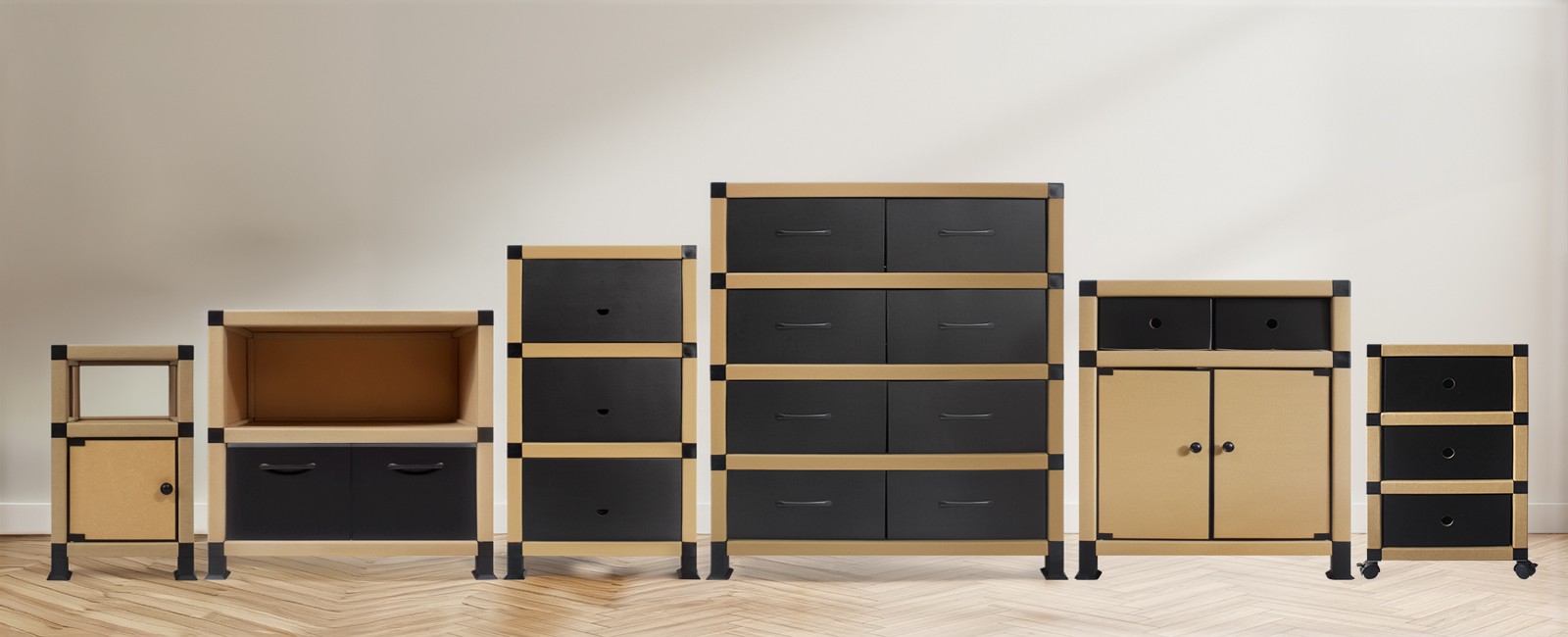
As consumers become more environmentally conscious, sustainable furniture is rapidly gaining popularity. Among the most innovative options are storage solutions made from paper-based materials. If you have been researching eco-friendly wardrobe alternatives, you have likely come across two terms: paper bedroom closet and cardboard closet. While both fall under the umbrella of recyclable, lightweight storage furniture, they are not the same. Understanding their differences can help you choose the right option for your bedroom, rental apartment, dormitory, or temporary living space.
A paper bedroom closet refers to a wardrobe system built primarily from high-strength paper tubes, reinforced paper panels, and modular connectors. Companies like MINHOU UNIMAX CO., LTD. have pioneered this category since 2009, developing patented structural systems that transform kraft paper into surprisingly durable furniture.
The key structural element is the paper tube. These tubes are created by tightly winding multiple layers of thick, reinforced paper under extreme pressure, producing dense, rigid cylinders. When arranged in a grid-like framework and connected with multi-prong polypropylene connectors, they form a stable skeleton capable of supporting significant weight. Some models can hold up to 50 kg of distributed load across shelves and withstand hanging-rod loads suitable for everyday clothing storage.
Paper bedroom closets from leading manufacturers also feature nano-coated surfaces that repel water and resist stains, plus plastic foot covers to isolate the structure from floor-level moisture. The result is a modular, tool-free assembly wardrobe that weighs roughly 20% to 30% as much as traditional wooden furniture, making it ideal for people who move frequently or live in small spaces.
A cardboard closet, by contrast, is typically constructed from corrugated cardboard or honeycomb-board panels. Corrugated cardboard consists of a fluted inner sheet sandwiched between two flat liner sheets, a design that provides decent bending resistance and cushioning properties. Honeycomb board uses a hexagonal cellular core structure that distributes loads more evenly and offers higher compressive strength than standard corrugated material.
Cardboard closets are often associated with temporary, disposable, or do-it-yourself storage solutions. They may arrive as flat-packed sheets that fold and slot together, or as pre-cut panels that require adhesive or tape for assembly. While some manufacturers now produce heavy-duty cardboard furniture using laminated, cross-layered sheets for improved structural integrity, the general market perception of cardboard closets still leans toward short-term or budget-oriented use.
| Feature | Paper Bedroom Closet | Cardboard Closet |
|---|---|---|
| Primary Material | High-strength paper tubes + reinforced panels + PP connectors | Corrugated cardboard or honeycomb-board panels |
| Structural Approach | Cylindrical tube framework with patented multi-prong connector system | Folded or slotted planar panels; sometimes taped or glued |
| Load-Bearing Capacity | High; engineered to support 50+ kg on shelves and adult-weight hanging loads | Moderate to low; best suited for light clothing and accessories |
| Assembly Method | Tool-free, detachable, and repeatable assembly using click-in connectors | Often requires folding, slotting, or adhesive; may weaken with re-assembly |
| Water & Stain Resistance | Nano-coated surfaces plus moisture-isolating foot covers | Generally untreated; highly vulnerable to moisture and humidity |
| Service Life | 1 to 5+ years with proper care; components repairable and replaceable | Typically months to 1–2 years; degrades faster in humid conditions |
| Weight & Portability | Very lightweight (often 10–15 kg); easy for one person to carry when disassembled | Lightweight, but bulkier panels can be awkward to transport flat |
| Intended Use Case | Daily bedroom storage, rental homes, dorms, offices, temporary spaces | Short-term storage, moving boxes, emergency shelters, pop-up displays |
| Customization | Modular; shelves, drawers, and hanging rods can be added or reconfigured | Limited; fixed dimensions and configurations in most cases |
The most important distinction between these two types of closets lies in their engineering. A paper tube functions much like a concrete column in architecture: its cylindrical shape distributes compressive forces evenly around the circumference, preventing buckling under load. When multiple tubes are linked via three-way or four-way connectors, the resulting framework behaves like a rigid truss system.
Flat cardboard panels, even when reinforced with honeycomb cores, rely on planar surfaces to resist bending. They perform reasonably well against forces applied perpendicular to their faces but are far more vulnerable to edge impacts, punctures, and moisture-induced delamination. Over time, repeated folding or slotting of cardboard joints can cause material fatigue, loosening the structure.
Your decision should depend on how you plan to use the closet and for how long:
While both paper bedroom closets and cardboard closets share the benefits of being lightweight, recyclable, and eco-friendly, they serve different purposes and are engineered to very different standards. A paper bedroom closet is a modular, high-strength furniture system built for repeated assembly, daily use, and multi-year service life. A cardboard closet is a simpler, planar-panel solution best reserved for temporary, light-duty applications. By understanding these differences, you can invest in the storage solution that truly matches your lifestyle, space, and sustainability goals.
