
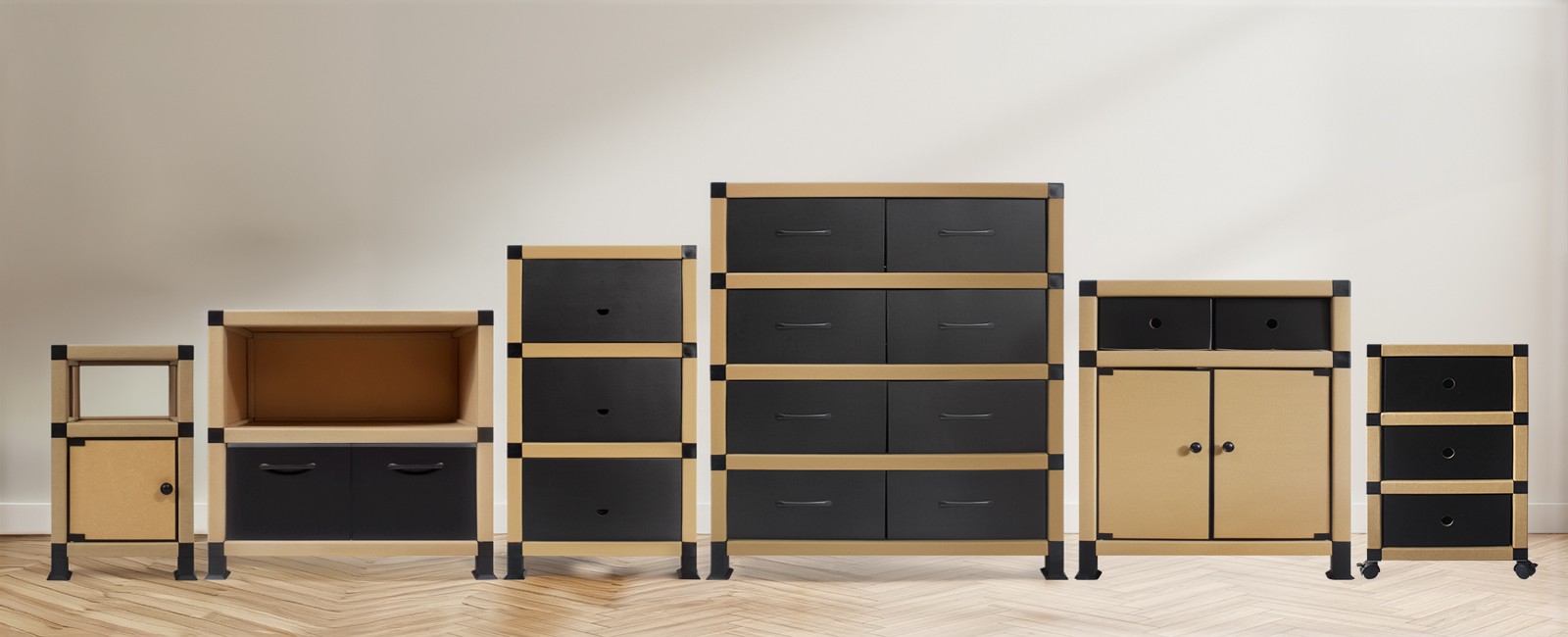
When you are preparing a nursery or reorganizing your home for a new baby, storage quickly becomes one of the biggest challenges. Diapers, wipes, onesies, blankets, toys, bottles, and feeding supplies pile up faster than most parents expect. While fabric bins and plastic drawers are common go-to solutions, a growing number of families are turning to flat pack furniture made from paper and cardboard as a smarter, greener alternative. This guide walks through what makes a great paper organizer for baby items and which options are worth your attention.
Traditional nursery storage often relies on plastic bins, metal frames, or synthetic fabric drawers. These materials work, but they come with trade-offs: plastic can emit odors, metal frames are heavy and hard to move, and synthetic fabrics are not always recyclable. Paper-based organizers solve several of these problems at once.
High-strength kraft paper, treated for water and stain resistance, provides a surface that is safe to use around babies. Unlike some plastics, quality paper furniture does not carry sharp chemical smells. The material is also lightweight, typically weighing only 20 to 30 percent as much as conventional wood furniture, which means you can reposition a paper organizer easily as your nursery layout changes.
For parents who care about sustainability, eco-friendly furniture made from recyclable paper is a natural fit. When your child eventually outgrows the nursery phase, the organizer can be recycled rather than sent to a landfill. This matters more than many parents realize, since baby gear tends to have a short usable lifespan.
Not every paper organizer is built the same way. When you are shopping for baby item storage, pay attention to these features:
Tool-Free Assembly
With a new baby at home, you do not have time to hunt for screwdrivers or follow complicated instruction manuals. Look for organizers that use multi-prong polypropylene connectors, which let you snap panels together by hand in minutes.
Modular Cube Design
Cube-style organizers let you sort baby items by category: one cube for diapers, another for onesies, a third for toys. As your storage needs grow, you can add more cubes or reconfigure the layout without buying an entirely new unit.
Wheels or Casters for Mobility
Midnight diaper changes are easier when your supplies come to you. A rolling organizer can sit beside the crib at night and move to the changing area during the day. Locking wheels keep it stable when parked.
Water- and Stain-Resistant Surface
Babies are messy. Spilled formula, drool, and diaper leaks are inevitable. A kraft paper surface with a protective coating can be wiped clean with a damp cloth, which is far more practical than fabric bins that require spot-cleaning or hand-washing.
Adequate Load Capacity
Baby items may seem light individually, but a shelf full of diaper packs, wipes, and folded blankets adds up. Quality paper tube furniture can support significant weight, with some structures rated for up to 50 kg per shelf. Always check the published load limits before loading up.
Based on the features above, here are several types of paper home organizer products that work particularly well for baby item storage:
A 6-cube or 9-cube paper organizer is arguably the most versatile option for a nursery. Each cube functions as a dedicated compartment, making it easy to separate diapers, clothing by size, toys, feeding supplies, and bedding. The vertical design takes advantage of wall space rather than floor space, which is essential in smaller nurseries.
For example, a 9-cube organizer measuring 120 x 42.5 x H125 cm provides nine separate compartments in a footprint that fits along one nursery wall. Parents can label each cube by content, and because the unit is made from recyclable kraft paper, it contributes to a healthier indoor environment compared to plastic alternatives.
A multi-storage organizer mounted on universal wheels is perfect for parents who need baby supplies within arm's reach at all times. During the day, roll it next to the changing table. At night, wheel it beside the crib for quick access to diapers and wipes without leaving the room.
These compact units typically measure around 52 to 65 cm wide and 62 to 76 cm tall, small enough to fit through a standard doorway. The combination of drawers and open shelves means you can keep some items visible for quick grabs and others tucked away. Look for models with locking wheels to prevent the unit from shifting when you reach for something.
A paper bedside table with drawers is an excellent choice for the space next to the crib or nursing chair. The drawers keep small items like pacifiers, nail clippers, and burp cloths contained, while the top surface holds a lamp, monitor, or a glass of water during late-night feedings.
Models with fabric drawers are particularly nursery-friendly because they are quiet to open, which matters when you are trying not to wake a sleeping baby. Some bedside tables also come with universal wheels, turning them into a mobile station that can follow you from room to room.
For items you want to keep out of sight and out of reach, a paper storage cabinet with doors is ideal. Baby medications, thermometers, grooming kits, and cleaning supplies can be stored behind closed doors, protecting them from dust and keeping them away from curious hands as your baby grows and becomes mobile.
Cabinets that combine doors with open shelves offer the best of both worlds. Use the closed section for supplies you want hidden, and the open shelf for frequently used items like lotions, diapers, and a changing mat. A typical unit measuring 67 x 42 x H82 cm fits comfortably in most nursery layouts.
Board books, picture books, and soft toys accumulate quickly. A 5-tier paper bookcase provides vertical storage that grows with your child. In the nursery phase, use lower shelves for baskets of toys and upper shelves for books and decorative items. As your child gets taller, they can reach the books themselves, encouraging independent reading habits.
A bookcase measuring 76 x 29 x H176 cm offers five full tiers of storage with a footprint under 30 cm deep, making it suitable even for tight spaces between the crib and the wall.
Having the right organizer is only half the battle. How you arrange items inside it makes a big difference in your daily routine. Here is a practical approach:
Sort by Frequency of Use
Place diapers, wipes, and burp cloths at eye level or in the top drawers. Store size-up clothing and backup supplies on lower shelves where you do not need them daily.
Label Every Section
Use adhesive labels or small cards on each cube or drawer. When grandparents or babysitters help, they will know exactly where everything goes.
Rotate Clothing by Size
Babies grow fast. Keep the current size in the most accessible drawer and the next size up behind it. When it is time to swap, simply move the larger size forward.
Keep a Dedicated Diaper Station
Reserve one drawer or cube for a diaper changing kit: diapers, wipes, cream, and a small changing mat. This makes it easy to grab everything at once, whether you are at the changing table or doing a quick change on the bed.
Paper furniture is safe for nursery use when you follow a few basic guidelines:
One of the biggest advantages of paper organizers over traditional nursery furniture is the flat-pack shipping format. Components arrive disassembled in compact cartons, which reduces shipping volume and cost. This is especially valuable if you are ordering online or if you live in an area where large furniture delivery is expensive.
Flat-pack paper furniture is also a lifesaver for families who move frequently. Whether you are transitioning from an apartment to a house, relocating for work, or simply rearranging the nursery, the organizer can be disassembled, transported flat, and reassembled in the new space without any tools. This is a significant advantage over heavy wooden dressers or fixed metal shelving units.
For parents who travel or split time between homes, a lightweight paper organizer can even be packed and brought along. It provides familiar, organized storage for baby items wherever you go, without the weight or bulk of conventional furniture.
A common question parents ask is whether paper furniture can hold up to daily nursery use. The answer depends on how the organizer is used and maintained, but quality paper furniture typically lasts one to five years in normal household conditions. In a nursery setting, where the furniture is used for storage rather than seating, it can easily serve through the baby and toddler years.
The key factors that affect lifespan are humidity, load management, and surface care. Keep the room well-ventilated, do not overload shelves, and wipe the surface clean rather than soaking it. If the protective coating gets scratched, repair it promptly with a compatible sealant to prevent moisture from reaching the paper underneath.
When the organizer eventually reaches the end of its useful life, it can be recycled at a local paper recycling facility. This circular lifecycle is one of the strongest reasons to choose paper over plastic for nursery storage.
Before purchasing, measure the available wall or floor space in your nursery. Here is a quick reference for matching organizer sizes to room layouts:
| Room Size | Recommended Organizer | Approximate Footprint |
|---|---|---|
| Small nursery (under 10 sqm) | Rolling multi-storage organizer | 52 to 65 cm wide, 62 to 76 cm tall |
| Medium nursery (10 to 15 sqm) | 6-cube organizer or bedside table with drawers | 40 to 81 cm wide, 84 to 126 cm tall |
| Large nursery (over 15 sqm) | 9-cube organizer or storage cabinet with doors | 67 to 120 cm wide, 82 to 125 cm tall |
| Shared room or multi-purpose space | 5-tier bookcase plus a rolling organizer | 76 cm wide bookcase, 52 cm wide roller |
The best flat pack paper organizer for baby items is one that matches your space, your daily routine, and your values. A multi-cube organizer gives you the most flexibility for sorting supplies by category. A rolling unit brings essentials to wherever you need them. A bedside table with drawers keeps small items contained and quiet. And a cabinet with doors hides the things you do not want on display.
What all of these options share is the combination of tool-free assembly, lightweight portability, and environmental responsibility that paper furniture offers. For parents who want a nursery that is organized, safe, and sustainable, flat pack paper organizers are a practical choice that performs well without compromising on health or environmental values.
If you are ready to explore specific models, browse the full range of paper organizers and storage furniture designed for homes, nurseries, and children's spaces. Each product is built from high-strength kraft paper with water-resistant treatment and patented connector systems, ensuring that your nursery storage is as sturdy as it is sustainable.
