

A home office is a room that has to do a dozen jobs at once, and bookshelves are often the piece that quietly carries the load. Between reference books, binders, printer paper, plants, and the occasional framed photo, the shelves fill up fast while the floor space stays stubbornly small. That is exactly why the 5-tier paper bookshelf keeps showing up in home-office setup guides: it uses vertical wall space instead of footprint, and it does so in a way that fits a room you actually live and work in.
But "best" has to mean more than "tall enough to hold a few novels." The right choice for a home office should be sturdy, easy to move when you rearrange the room, honest about what it can carry, and—these days—easy to dispose of responsibly when its work is done. Here is what to look for, and why the 5-tier paper bookshelf from MINHOU UNIMAX checks every one of those boxes.
A home office rarely has the wall width to go wide, so the smart approach is to go up. Four tiers shrug at a standard stack of paperbacks before you reach the top, while six or more start to feel like a ladder you need to climb. Five shelves give you a workable rhythm: reference books and frequently used notebooks on the middle and lower shelves, décor and plants on the top, and a low shelf near the floor for heavy binders and files that can sit safely under your desk height.
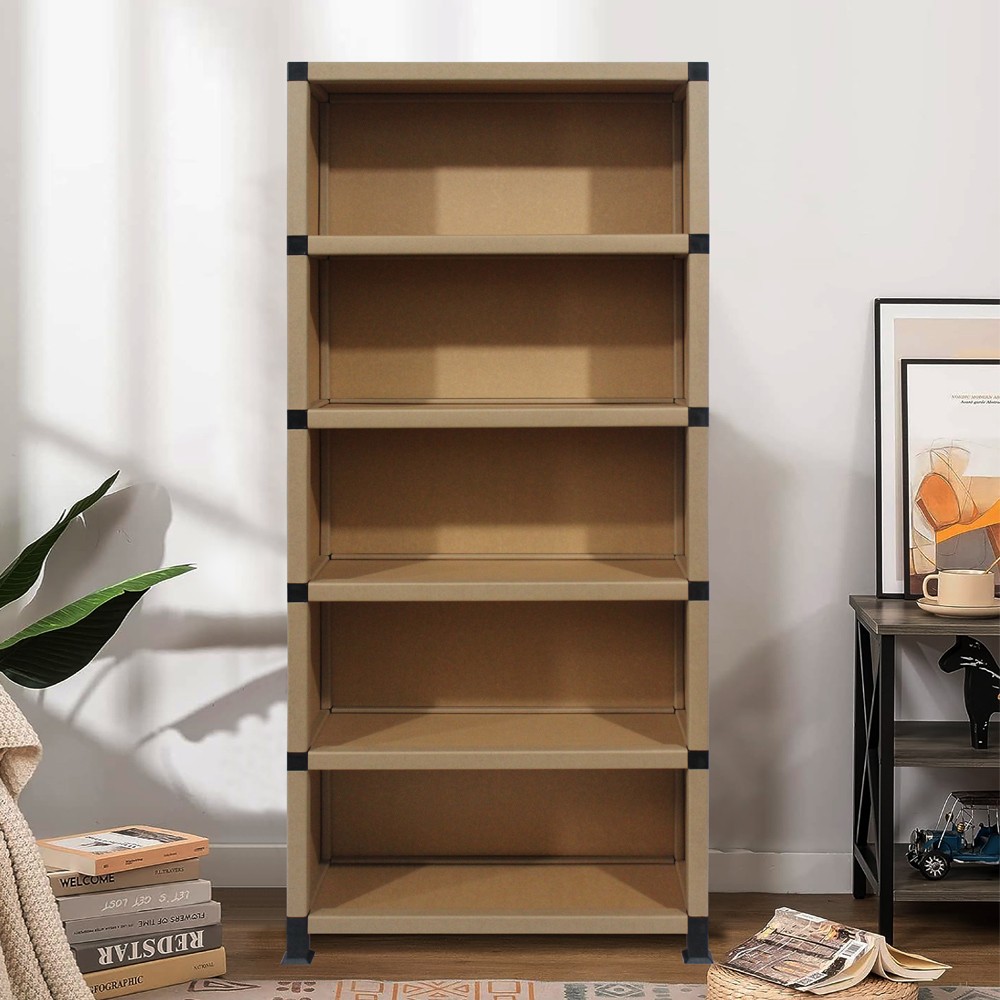
The model worth looking at is the UM24027, a paper bookcase measuring 76 × 29 × H176 cm. It keeps a narrow 29 cm depth so it slides into a corner or sits flush against a wall without pushing into your desk space, yet the 176 cm height stretches comfortably toward the ceiling. For a small home office, that slender vertical profile is the difference between a cluttered room and an organized one.
The word "paper" makes most people picture a flimsy moving box, and that assumption is worth correcting before you compare options. A quality paper bookshelf is built from three engineered parts: high-strength paper tubes that form the vertical spine, reinforced paper panels that make up the shelves, and multi-prong polypropylene connectors that lock the tubes together with a simple twist.
Nothing in that setup needs a single tool, a screw, or a hammer. The panels click into the connectors by hand, and the whole structure can be taken apart just as easily. That matters in a home office for a very practical reason: when you decide to shift the bookshelf to the other wall, or clear the room for a video call background, you can disassemble it in minutes, move it, and rebuild it without leaving a scratch on the floor.
The most common excuse for avoiding paper furniture is doubt about weight. The design answer for the bookshelf is even weight distribution. The connectors spread the load across every joint rather than letting a single point carry everything, and the horizontal shelves distribute books across reinforced panels. The company specifies a total working capacity of about 50 kg for the bookshelf—enough for a working stack of hardcovers and file folders, which covers most home-office collections comfortably.
It is worth being honest about limits: this is not the shelf you choose to park a desktop PC tower or an aquarium on. For books, binders, stationery, and décor, though, the structure is more than adequate, and the surface treatment gives the kraft paper water and stain resistance so a spilled coffee does not mean the end of a shelf.
Home-office furniture earns its place by making everyday work easier, and a paper bookshelf earns it in three small ways that add up. First, it is genuinely lightweight—the company builds its paper furniture at roughly 20 to 30 percent of the weight of conventional furniture—so even a fully loaded shelf is manageable when you need to shift it. Second, it ships and stores flat in a carton, which keeps freight costs down if you are furnishing a new office or moving between rentals. Third, when the shelf has finished its useful life, the paper materials can be recycled rather than sent to a landfill.
That recyclability is the quiet advantage that wood, metal, and plastic bookshelves simply do not match. Wood takes decades to grow and is heavy to move; metal consumes a lot of energy to produce; plastic is hard to dispose of responsibly. A paper bookcase is renewable at the start of its life and recyclable at the end, which is the whole point of low-carbon living room and office furniture.
Measure the corner, not just the wall. A 5-tier paper bookshelf is tall, so confirm your ceiling clearance and check that the 29 cm depth clears any door frames or window sills it will sit behind.
Keep it out of damp spots. Paper is a strong material, but it is still paper. Place the bookshelf away from radiators and leaking windows, and tuck the included foot caps under the base so it never sits directly on a wet floor.
Follow the load limit. Spread heavier binders across the lower shelves and keep the top shelf for lightweight décor. Respecting the 50 kg total capacity keeps every joint tight and the whole structure steady for years.
The best 5-tier paper bookshelf for a home office is the one that disappears into your routine: tall enough to hold what you actually use, narrow enough to fit a real room, light enough to move, and kind enough to the environment that disposing of it is a small, guilt-free act. The 5-tier paper bookshelf from MINHOU UNIMAX delivers exactly that. It assembles in minutes without tools, carries a practical load of books and files, and slots neatly into the corner of even a compact office. If you are equipping a home office, it deserves a close look before you settle for another heavy wooden shelf.
