
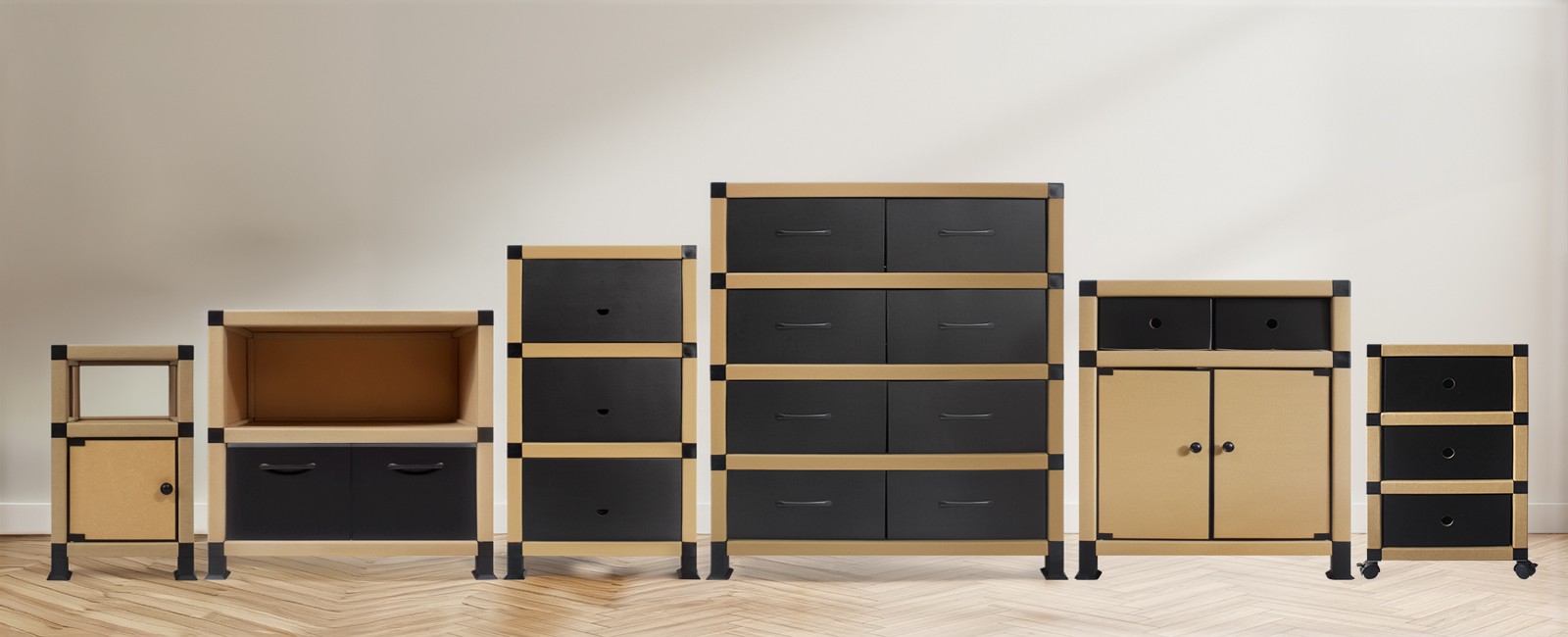
The furniture industry has changed. Buyers no longer just want products that look good — they want materials that are responsible, logistics that are efficient, and suppliers who actually understand what they sell. Paper furniture has moved from a niche curiosity to a legitimate category, but the gap between a well-engineered product and a poorly made one is enormous. That gap is exactly where the choice of paper furniture manufacturer becomes critical.
Working with a specialized manufacturer rather than a generic factory or a DIY approach changes nearly every aspect of the product — from structural performance to shipping costs to environmental credentials. Below is a practical breakdown of what a professional manufacturer brings to the table.
The biggest misconception about paper furniture is that it is fragile. A properly engineered product tells a different story. High-strength kraft paper tubes, when wound densely and combined with reinforced panels and precision connectors, create structures that handle real-world loads. A well-built paper bookshelf can carry up to 50 kg across its shelves. Selected structures can support an adult weighing up to 80 kg without deformation.
These numbers do not come from wishful thinking — they come from manufacturing processes that treat paper as an engineering material, not a disposable one. A specialized manufacturer invests in tube density, panel lamination, and connector geometry to make sure each piece performs as specified. Without that engineering discipline, you get cardboard that sags after a month.
The real innovation in modern paper furniture is not the paper itself — it is how the pieces connect. Professional manufacturers develop proprietary connector systems that eliminate the need for glue, nails, or screws. Multi-prong polypropylene (PP) connectors, three-way joints, and square-tube connectors lock tubes and panels into rigid frames that can be assembled and disassembled repeatedly without structural wear.
This matters for two reasons. First, it means tool-free assembly — a customer can put together a nightstand or a bookshelf in minutes without hardware. Second, it means the furniture is genuinely modular and removable, which is a selling point for renters, students, and anyone who relocates regularly.
One advantage of sourcing from an established eco-friendly furniture manufacturer is catalog depth. A specialized producer does not just make one type of product — they cover an entire living space. Typical categories include:
| Category | What It Covers | Common Use Cases |
|---|---|---|
| Bedside tables | Nightstands, dressers, narrow side tables with drawers or open shelves | Bedrooms, small apartments, rental units |
| Bedroom wardrobes | Freestanding closets and wardrobes in multiple heights | Rental bedrooms, temporary housing, dorm rooms |
| Sofa side tables | End tables with drawers, narrow accent tables | Living rooms, studio apartments |
| Living room cabinets | Storage cabinets with doors, drawers, and open shelving | Living rooms, offices, display spaces |
| Home organizers | 6-cube and 9-cube organizers, wheeled storage units, large shelves | Home offices, children's rooms, garages, pantries |
| Bookcases | 5-tier bookshelves and compact storage units | Home libraries, offices, study areas |
| Children's desks and seating | Desk-and-chair sets, play tables with four seats | Nurseries, playrooms, classrooms |
| Pet houses | Cat houses sized for standard litter boxes | Apartments, pet-friendly homes |
For a retailer or distributor, this range matters. It means you can source an entire collection from one supplier rather than piecing together products from multiple factories with inconsistent quality and finish standards.
A professional manufacturer does not just sell from a fixed catalog. They offer real customization — dimensions, colors, surface finishes, and even entirely new designs based on buyer specifications. This is essential for brands that want private-label products, retailers with specific aesthetic requirements, or project designers who need furniture that fits a particular space.
OEM capability also means the manufacturer can produce to your brand standards rather than their own. For wholesale buyers and importers, this is the difference between selling a generic product and building a brand identity in the market.
Selling sustainable furniture is easy to claim but harder to prove. A legitimate manufacturer backs their environmental story with recognized certifications. Two of the most important in this industry are:
Beyond certifications, the sustainability story is practical. Paper furniture weighs roughly 20 to 30 percent of what traditional furniture weighs. Flat-pack shipping means more units per container, fewer trucks on the road, and lower transport emissions. At end of life, the products recycle through standard paper streams — no special disassembly or hazardous material handling required.
A manufacturer worth working with does not skip testing. Paper furniture intended for homes, children's rooms, and offices should pass material safety assessments covering formaldehyde emissions, heavy metals (POP/PCP), cadmium, and phthalates. These tests confirm that the product is safe for everyday indoor use, including spaces where children and pets spend time.
Surface treatment is another area where professional manufacturing makes a difference. Quality kraft paper receives specialized treatment for water and stain resistance, meaning accidental spills can be wiped clean without damaging the structure. This is a far cry from untreated cardboard that warps at the first contact with moisture.
Shipping assembled furniture is expensive and wasteful. A professional manufacturer designs every product for knock-down (K/D) flat-pack shipping — tubes, panels, and connectors packed separately in cartons. This approach reduces shipping volume dramatically, which means:
For wholesale buyers and importers, these logistics savings compound across large orders and directly affect retail pricing competitiveness.
Practical example: A 5-tier paper bookshelf (model UM24027, 76 × 29 × H176 cm) ships flat in a compact carton but assembles into a full-height storage unit that holds up to 50 kg of books and decorative items. A 9-cube organizer (model UM24049, 120 × 42.5 × H125 cm) provides large-capacity storage with a minimal footprint — all from flat-pack components that one person can assemble without tools.
Different buyers benefit from different aspects of working with a specialized paper furniture producer:
Paper furniture is not a product you can manufacture well without years of accumulated knowledge. Material behavior, tube density optimization, connector tolerance, and surface treatment chemistry all require iteration and refinement. A company that has been manufacturing paper furniture since 2009 has weathered design challenges, tested load scenarios, and refined production processes that a newcomer simply has not encountered.
That experience also translates into better quality control — from material selection and precision cutting through to modular assembly and packaging. Consistency matters when you are shipping hundreds or thousands of units to international markets, and only an established manufacturer can deliver it reliably.
The benefits of working with a professional paper furniture manufacturer come down to this: you get products that are engineered, tested, certified, and customizable — not improvised. You get a supply partner who understands the material, stands behind the quality, and can scale with your business. And you get a sustainability story that holds up under scrutiny because it is backed by documentation, not just marketing copy.
If you are sourcing paper furniture for retail, wholesale, or a specific project, the manufacturer you choose will determine everything from product performance to customer satisfaction to your bottom line. Choose one with the experience, certifications, and product range to deliver on every front.
