
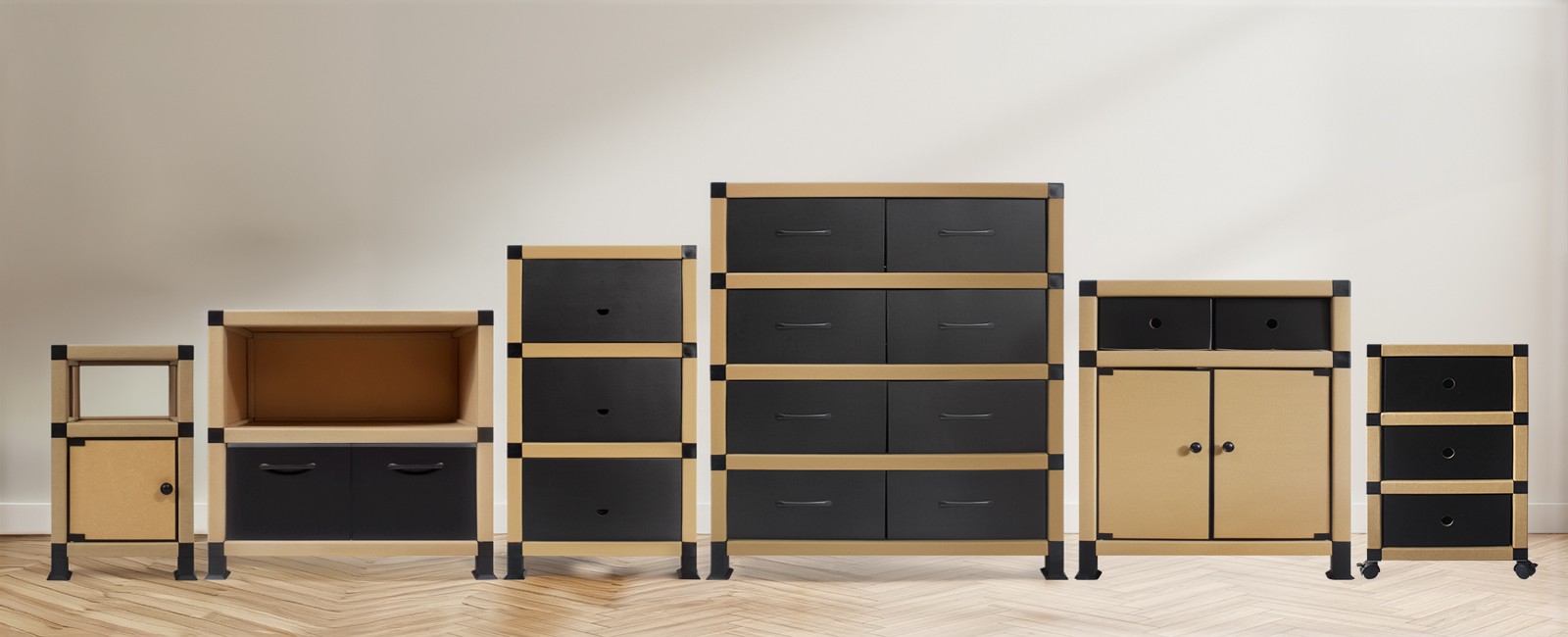
Walk into any forward-thinking retail space today and you may notice something different about the shelves, display tables, and storage units surrounding the merchandise. They are increasingly made from paper, cardboard, and other renewable materials rather than solid wood or metal. This shift is not a gimmick. Retailers are discovering that green furniture for retailers delivers measurable advantages across cost, logistics, customer engagement, and brand positioning. This article breaks down the concrete benefits that make eco-friendly furniture a practical choice for retail businesses, not just an environmental statement.
Traditional retail furniture made from wood, metal, or engineered boards carries significant material and manufacturing costs. Paper-based and cardboard furniture, by contrast, uses kraft paper tubes, reinforced panels, and polypropylene connectors that are far less expensive to produce. Retailers sourcing wholesale paper furniture often find that per-unit prices run substantially lower than conventional equivalents, especially when ordering in bulk.
The savings extend beyond the unit price. Because paper furniture is designed for flat-pack shipping, retailers pay less for freight. Disassembled components packed in cartons take up a fraction of the volume that assembled furniture would occupy, meaning fewer delivery trucks, lower fuel costs, and reduced warehousing overhead. For retailers operating multiple locations or managing frequent store refreshes, these logistics savings compound quickly.
Anyone who has assembled traditional flat-pack furniture knows the frustration of missing screws, confusing instructions, and hours spent with an Allen wrench. Green paper furniture eliminates this pain point entirely. Products from manufacturers like MINHOU UNIMAX use multi-prong connector systems that snap together by hand. No screws, no tools, no hardware to lose.
For retailers, this means a single staff member can assemble a display shelf, bedside table, or storage cabinet in minutes rather than hours. Store refreshes that once required a full day of setup can be completed in a morning. Pop-up shops and temporary exhibition booths can be built and torn down rapidly, reducing labor costs and minimizing downtime. The connector systems are also designed for repeated assembly and disassembly, so furniture can be taken apart, transported to a new location, and rebuilt without structural degradation.
Paper-based furniture weighs roughly 20 to 30 percent as much as comparable traditional pieces, according to manufacturer specifications. This dramatic weight reduction has practical implications throughout the retail lifecycle. Delivery drivers handle packages more easily. Store staff can reposition display units without equipment or assistance. When a layout change is needed, a single person can lift and move a paper bookshelf or cabinet rather than calling for a two-person team.
The reduced weight also lowers the risk of workplace injuries during setup and rearrangement. And because the furniture is lighter, it places less stress on flooring, which matters in older buildings or temporary venues where floor load capacity may be a concern.
A common concern about paper furniture is whether it can hold up under real-world conditions. Manufacturers address this through engineered construction. High-strength kraft paper tubes, reinforced panels, and patented three-way and multi-way connectors distribute weight across the structure rather than concentrating it at single joints. According to manufacturer claims, selected structures can support an adult weighing up to 80 kilograms, and a paper bookshelf can carry a total load of 50 kilograms.
For retailers, this means paper display tables can hold product samples, storage cabinets can organize inventory, and bookshelves can stock merchandise without bowing or collapsing. The kraft paper also receives water- and stain-resistant surface treatments, so accidental spills at a display table do not immediately ruin the unit. Retailers should still verify load ratings for their specific use case before deployment, but the engineering behind these products is purposeful, not accidental.
Today's consumers are not easily fooled by vague green claims. They want proof, detail, and accountability. When a retailer can point to furniture made from recyclable kraft paper, certified by FSC, and manufactured under BSCI compliance, that retailer has a story customers can verify. Sustainable furniture gives retailers a tangible way to demonstrate environmental commitment without relying on marketing language alone.
This authenticity matters because eco-conscious shoppers are not a fringe demographic. They represent a growing segment that actively seeks out brands aligned with their values. A store outfitted with paper-based display furniture sends a visible signal that the retailer walks the talk. Customers notice the material, ask questions, and walk away with a brand impression rooted in environmental responsibility rather than empty slogans.
Green paper furniture is not limited to a single retail scenario. Its modular, flat-pack nature makes it suitable for a wide range of applications:
The same flat-pack design that benefits shipping also makes storage straightforward. Retailers can keep disassembled units in stock and build them on demand, reducing the floor space dedicated to display inventory and keeping backroom clutter to a minimum.
Reputable green furniture manufacturers back their products with third-party certifications. For example, MINHOU UNIMAX has maintained BSCI and FSC membership for years and displays test reports covering formaldehyde levels, load capacity, and chemical safety including POP/PCP, cadmium, and phthalates. These certifications matter for retailers because they provide defensible proof when customers ask about product safety and environmental claims.
Regulatory compliance is another consideration. Furniture sold in certain markets must meet specific chemical and material standards. Having test reports and certifications available streamlines the compliance process and protects retailers from liability. Before committing to a supplier, retailers should request current certificates and verify that the documentation covers the specific product models they intend to stock.
Paper furniture is highly receptive to customization. The material takes paint, digital printing, and applied graphics readily, which means retailers can match display furniture to brand colors, apply logos, or create themed visual merchandising without special manufacturing runs. For retailers interested in private label programs, manufacturers offer OEM services that allow them to sell furniture under their own brand identity.
This customization extends to product configuration. Modular connector systems allow different product sizes and layouts from the same set of components. A retailer can order paper tubes, panels, and connectors in bulk and configure them into bedside tables, storage cabinets, or bookshelves depending on current merchandising needs. This flexibility reduces the need to stock dozens of specific product SKUs and instead allows inventory to adapt to demand.
When traditional furniture reaches the end of its useful life, it often ends up in landfills. Composite boards with glued layers, metal fittings, and plastic components are difficult to separate and recycle. Paper furniture, by contrast, is designed with end-of-life in mind. The kraft paper tubes and panels are recyclable, and the polypropylene connectors can be separated and processed independently. This reduces waste disposal costs for retailers and aligns with circular economy principles that increasingly inform corporate sustainability reporting.
The manufacturer notes that paper furniture typically has a service life of one to five years depending on usage and environment, and may exceed five years under suitable conditions. For retailers who refresh displays seasonally or rotate store layouts regularly, this lifespan is well-matched to the replacement cycle. Rather than investing in durable furniture that becomes outdated before it wears out, retailers can use paper furniture that performs for its intended period and then recycles cleanly.
For retailers ready to explore green furniture, a structured approach helps ensure a smooth transition:
Green furniture is not a compromise for retailers. It is a practical category that lowers costs, simplifies logistics, speeds up operations, attracts environmentally conscious customers, and provides verifiable sustainability credentials. Paper-based furniture from established manufacturers combines engineered strength with lightweight convenience, flat-pack efficiency, and end-of-life recyclability. For retailers looking to differentiate their stores, reduce overhead, and align with shifting consumer values, the benefits of green furniture extend well beyond environmental goodwill into measurable business advantage.
The furniture industry is moving toward materials and designs that serve both commerce and conscience. Retailers who adopt green furniture early position themselves ahead of that curve, building stores that customers respect and operations that make financial sense.
