
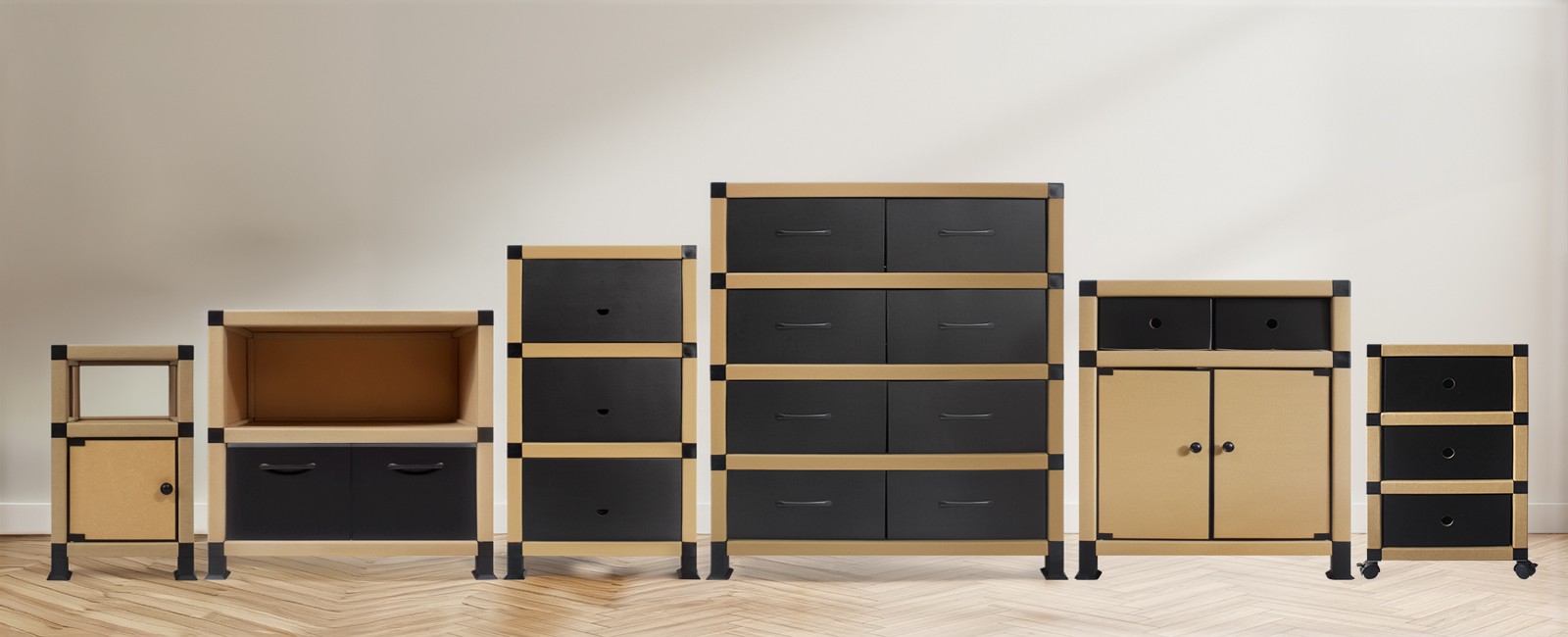
The modern workplace is undergoing a quiet but profound transformation. As organizations confront rising carbon targets, tightening indoor air quality regulations, and shifting employee expectations, the furniture that fills offices can no longer be an afterthought. Conventional office furniture, typically built from particleboard, virgin plastics, and metal frames joined with synthetic adhesives, carries hidden costs that extend far beyond the purchase price. Sustainable office furniture offers a fundamentally different value proposition, one that addresses environmental impact, workplace health, long-term economics, and design flexibility simultaneously. This article examines the concrete advantages that sustainable alternatives hold over conventional office furniture across these dimensions.
Conventional office furniture relies heavily on resource-intensive materials. Particleboard and MDF require virgin wood fibers pressed with formaldehyde-based resins. Plastic components are derived from petroleum. Metal frames demand energy-consuming smelting and machining. Once these pieces reach the end of their useful life, the composite construction makes separation and recycling difficult, and the majority ends up in landfills.
Sustainable furniture takes a different approach from the outset. Manufacturers select renewable, recycled, or rapidly regenerating materials and design products so that components can be separated and recovered at end-of-life. For example, furniture made from high-strength kraft paper tubes and reinforced paper panels uses wood pulp from managed forestry sources and requires significantly less energy to process than steel or injection-molded plastic. The production of paper-based components avoids the high-temperature kiln firing, chemical coating baths, and solvent-based finishing that characterize conventional furniture manufacturing.
Transportation is another factor where sustainable furniture outperforms. Flat-pack designs that disassemble into compact cartons reduce shipping volume substantially. Fewer truckloads mean lower fuel consumption and fewer emissions across the supply chain. When the product eventually reaches retirement, single-material or easily separable construction allows components to enter standard recycling streams rather than contributing to landfill mass.
Indoor air quality is a critical but often overlooked dimension of office furniture. Conventional pieces off-gas volatile organic compounds (VOCs) from adhesives, finishes, flame retardants, and synthetic fabrics. These emissions can persist for months or years after installation, contributing to headaches, respiratory irritation, and a condition sometimes called sick building syndrome. Some conventional furniture also contains brominated flame retardants, phthalates, and per- and polyfluoroalkyl substances (PFAS), which are associated with endocrine disruption and other long-term health concerns.
Eco-friendly furniture minimizes or eliminates these risks by choosing materials and finishes that are inherently low in harmful emissions. Paper-based furniture, for instance, avoids the formaldehyde-laden resins found in particleboard. Reputable manufacturers subject their materials to third-party testing for formaldehyde, heavy metals such as cadmium and lead, and plasticizers including phthalates. Certifications such as FSC for responsibly sourced fiber and BSCI for ethical production provide additional assurance that the supply chain meets recognized health and environmental benchmarks.
For employers, the payoff is measurable. Studies of green-certified office environments have linked improved air quality to reduced absenteeism, fewer reported headaches, and better self-reported productivity. Choosing furniture that does not introduce pollutants into the workspace is one of the most direct ways to support these outcomes.
A common misconception is that sustainable furniture is always more expensive than conventional alternatives. While the initial purchase price may sometimes be comparable or slightly higher, the total cost of ownership tells a different story when the full lifecycle is considered.
Conventional furniture often follows a linear use-and-discard pattern. A damaged shelf, dented panel, or broken hinge can render an entire unit unusable because components are glued or permanently fastened together. The only option is replacement, which means paying for a new product plus disposal fees for the old one. By contrast, modular sustainable furniture is designed for disassembly. Individual components such as shelves, panels, and connectors can be replaced independently, extending the product's service life and spreading the initial investment over more years of use.
Shipping and logistics also favor sustainable flat-pack designs. Compact packaging reduces freight costs, which is especially significant for organizations furnishing multiple locations or importing furniture. Lighter weight further lowers transportation expenses. For businesses operating across regions or managing temporary installations such as pop-up stores, trade show booths, or seasonal offices, these savings accumulate quickly.
Today's offices are not static. Teams grow and shrink, departments reorganize, and hybrid work models demand spaces that can be reconfigured on short notice. Conventional furniture, with its fixed construction and heavy weight, resists this kind of adaptability. Moving a solid wood desk or a bolted metal storage cabinet typically requires multiple people, specialized equipment, and potentially wall repairs.
Sustainable modular furniture is built for change. Consider the approach taken by manufacturers like MINHOU UNIMAX, whose paper-based furniture systems use multi-prong polypropylene connectors to join high-strength paper tubes and reinforced panels. This construction method enables tool-free assembly and disassembly, meaning a bookshelf can be taken apart, moved to a new floor, and reassembled in minutes. Products such as mobile storage organizers with universal wheels can be rolled between rooms as needs shift. Cube-based organizers can expand from six compartments to nine as storage demands grow.
This flexibility also supports circular economy practices within the office. When a department downsizes, furniture can be disassembled, stored flat, and redeployed elsewhere rather than discarded. When an organization relocates, flat-pack designs reduce moving costs and minimize the risk of damage in transit. The modular connector system means that parts are interchangeable across compatible product lines, so a shelf from one unit can serve as a replacement for another.
The end-of-life stage reveals one of the sharpest contrasts between sustainable and conventional office furniture. A conventional desk finished with laminate veneer and assembled with construction adhesive is nearly impossible to recycle. The wood, plastic, and metal layers cannot be separated economically, so the unit is typically sent to a landfill where it may take decades to decompose while leaching residual chemicals.
Recyclable furniture designed with circular principles avoids this fate. Paper-based furniture components can be broken down and placed in standard paper recycling streams. Polypropylene connectors are recyclable as plastic. Because the materials are not permanently bonded, separation at end-of-life is straightforward. Some manufacturers also offer take-back or recycling programs, ensuring that retired products are processed responsibly rather than becoming waste.
This circular approach aligns with corporate sustainability goals and green building certifications such as LEED, which reward the use of recyclable materials and waste diversion strategies. For organizations that must report on environmental performance, furniture that can be quantifiably tracked through its full lifecycle provides verifiable data for sustainability reporting.
The advantages of sustainable office furniture are not limited to a single use case. Paper-based storage cabinets provide enclosed and open shelving for documents and supplies in administrative areas. Modular bookcases with five-tier vertical designs maximize storage in small footprints, ideal for home offices or co-working spaces. Mobile organizers on casters serve as flexible shared storage in open-plan layouts. Narrow side tables function as compact work surfaces beside lounge seating in reception areas.
For temporary or transitional spaces, the benefits are even more pronounced. Trade show booths, pop-up retail displays, and short-term project offices can be furnished with lightweight modular pieces that assemble without tools, transport in compact cartons, and disassemble for reuse at the next location. When the temporary need ends, the furniture can be stored flat or recycled rather than discarded.
A fair question is whether sustainable materials can match the durability of conventional furniture. Modern paper-based furniture addresses this through engineered construction. High-strength kraft paper tubes undergo compression treatment to achieve load-bearing capacity comparable to traditional materials in appropriate use cases. Patented three-way and multi-prong connector systems distribute weight across multiple contact points, improving structural stability. Water- and stain-resistant surface treatments protect against everyday spills and humidity.
That said, sustainable paper-based furniture is best understood as a solution for light-to-medium duty applications such as storage, organization, display, and transitional use. For heavy-load scenarios such as seating for adults or load-bearing workbenches, manufacturers provide specific load ratings that should be consulted before deployment. The service life of paper furniture, typically one to five years depending on conditions, can extend beyond five years with proper care, controlled humidity, and adherence to published load limits. This makes it particularly well-suited for rental offices, student workspaces, temporary installations, and environments where flexibility matters more than decades-long permanence.
The advantages of sustainable office furniture over conventional alternatives extend well beyond environmental goodwill. Lower production energy, reduced transportation emissions, healthier indoor air, modular repairability, lower lifecycle costs, and circular end-of-life pathways collectively make a compelling case for organizations rethinking their furniture procurement. Conventional furniture optimized for a linear take-make-dispose model no longer aligns with the operational, financial, and environmental realities of modern workplaces.
By choosing furniture made from renewable, recyclable materials with modular construction, organizations gain adaptability, cost savings, and a tangible contribution to their sustainability commitments. Whether outfitting a permanent headquarters, furnishing a rental workspace, or setting up a temporary installation, sustainable office furniture delivers practical performance without the hidden costs embedded in conventional alternatives. To explore a full catalog of modular, recyclable paper-based furniture solutions, visit the product catalog or contact the team at MINHOU UNIMAX for more information.
