
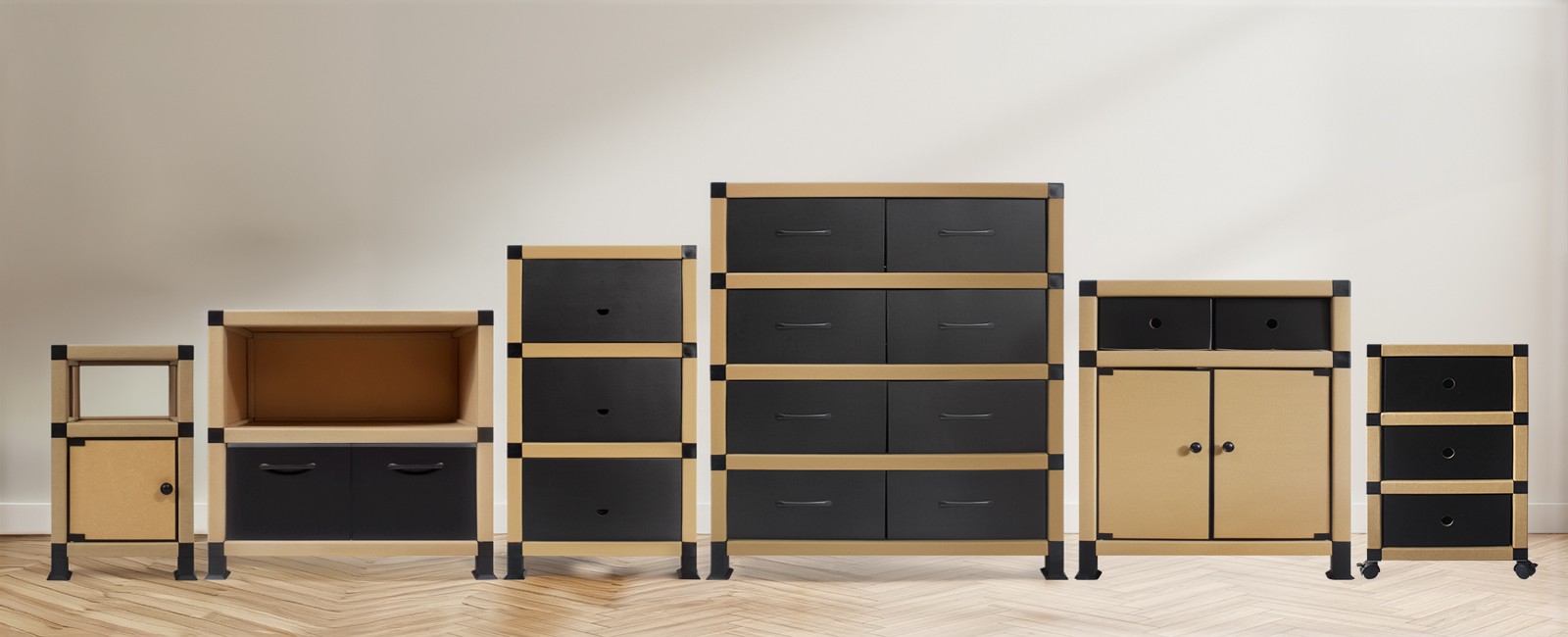
The secret behind paper furniture lies in a principle well understood by civil engineers: cylindrical structures distribute stress uniformly across their walls. A flat sheet of paper bends under almost no weight, but roll that same sheet into a tight cylinder, and it suddenly resists compression along its axis. This is the same reason concrete columns are round, why pipes handle pressure so well, and why bamboo — nature's own hollow cylinder — is stronger than many types of wood for its weight.
Manufacturers like MINHOU UNIMAX take this principle further by rolling multiple layers of high-strength kraft paper under pressure, creating thick-walled paper tubes with exceptional rigidity. The more layers and the tighter the wind, the greater the compressive and bending strength. The result is a structural member that punches far above its weight class, delivering functional strength at a fraction of the mass of solid wood or metal.
No single component works in isolation. Cardboard furniture from MINHOU UNIMAX relies on a three-part engineered system that works together to create stable, durable pieces:
High-strength paper tubes serve as the vertical and horizontal frame — the skeleton of each piece. These tubes are precision-cut to exact lengths so that every joint aligns perfectly during assembly.
Reinforced paper panels provide shelf surfaces, drawer bottoms, and side walls. Made from layered, compressed paper board, these panels distribute weight across the tube frame while adding rigidity to the overall structure.
Multi-prong polypropylene connectors are the patented innovation that ties everything together. These three-way and four-way connectors slot inside the paper tubes, creating tight, wobble-free joints that can be assembled and disassembled repeatedly without losing their grip. The connector design is what makes tool-free assembly furniture possible — no screws, no dowels, no Allen wrenches required.
The most frequent objection to paper furniture is, predictably, "What about water?" It is a fair question. Ordinary cardboard dissolves on contact with moisture. But water-resistant cardboard furniture uses specially treated kraft paper that repels liquids and resists staining.
The kraft paper used in MINHOU UNIMAX products receives a surface treatment that creates a protective barrier. This is where nano-coated sustainable furniture technology comes into play — microscopic particles bond with the paper fibres to create a hydrophobic surface that causes water to bead up rather than soak in. Spills can be wiped away before they cause damage, and everyday humidity is no threat to the structural integrity of the piece.
This surface treatment also improves scratch resistance and makes the furniture easier to clean — a critical feature for households with children, renters who move frequently, and anyone who wants furniture that looks good longer without demanding special care.
Numbers tell the story better than descriptions. Here is how the load-bearing cardboard structure performs across key product categories, based on manufacturer specifications and test reports:
| Product Type | Example Model | Dimensions | Key Strength Feature |
|---|---|---|---|
| 5-Tier Bookcase | UM24027 | 76 × 29 × H176 cm | Total load capacity up to 50 kg |
| Paper Nightstand | UM24023 | 40.5 × 34.5 × H68.5 cm | Water-resistant top surface |
| 9-Cube Organizer | UM24049 | 120 × 42.5 × H125 cm | Modular load distribution across cubes |
| Living Room Cabinet | UM24054 | 80 × 30.5 × H95 cm | Multi-compartment reinforced panels |
| Full-Height Wardrobe | UM240130 | 77 × 65 × H160 cm | Vertical tube frame stability |
| Children's Desk & Seat | UM24046A | Desk: 53.5 × 38.5 × H76 cm | Child-safe lightweight strength |
These numbers reflect the manufacturer's published specifications and test data. For buyers evaluating sustainable furniture for commercial or safety-critical applications, current test reports should be requested directly from the company.
Strength is only part of the equation. What makes modular furniture made from paper tubes genuinely innovative is how well it adapts to changing circumstances. The connector system that creates strong joints also makes disassembly and reconfiguration straightforward.
Consider the difference between a built-in wooden bookshelf and a paper tube modular system. The wood version is permanent — when you move, you either leave it behind or pay to have it demolished and rebuilt. The paper version disassembles into flat components, fits into a car, and reassembles in a new room in minutes. If your storage needs grow, you can add cubes or tiers. If they shrink, you can scale back.
This modularity also extends to flat pack furniture economics. Because every component ships disassembled in a compact carton, container utilization is high, shipping costs per unit are low, and the carbon footprint associated with transportation drops significantly compared to pre-assembled furniture.
The unique combination of strength, light weight, tool-free assembly, and recyclability makes paper tube furniture well suited to a surprising range of environments:
Eco-friendly furniture should not mean compromising on safety or quality. MINHOU UNIMAX, the manufacturer behind the paper tube furniture line, has been producing home furnishings since 2009 and holds memberships in BSCI (Business Social Compliance Initiative) and FSC (Forest Stewardship Council), demonstrating commitments to both ethical production and responsible material sourcing.
The company also holds patents for its connector systems and provides test reports covering formaldehyde emissions, load capacity, POP/PCP, cadmium, and phthalates. These reports give buyers — whether individual consumers, retailers, or wholesale partners — documented confidence that the products meet safety and performance standards.
Paper tube furniture is not trying to replace every piece of furniture in every home. Heavy-load permanent installations, heirloom-quality dining sets, and outdoor furniture exposed to the elements are better served by traditional materials. But for storage, display, light-use seating, transitional spaces, and anyone who values flexibility and low environmental impact, it offers a compelling alternative.
The real question is not "can paper be strong enough?" — engineering has already answered that with a resounding yes. The question is whether you are ready to furnish your space with something that is lighter to move, easier to assemble, gentler on the planet, and genuinely surprising in its capability.
MINHOU UNIMAX offers 33 products across 8 categories, from paper bedside tables and bedroom wardrobes to living room cabinets, home organizers, bookcases, children's furniture, and even pet houses. Each piece is built on the same high-strength paper tube foundation, with patented connectors, water-resistant surfaces, and tool-free assembly.
Whether you are furnishing a rental apartment, outfitting a startup office, sourcing wholesale paper furniture for retail, or exploring OEM cardboard furniture supplier partnerships for your own brand, MINHOU UNIMAX has the engineering and the product range to support your needs.
Visit www.fz-unimax.com to browse the full catalog, request samples, or contact the team directly to discuss custom and bulk orders.
