
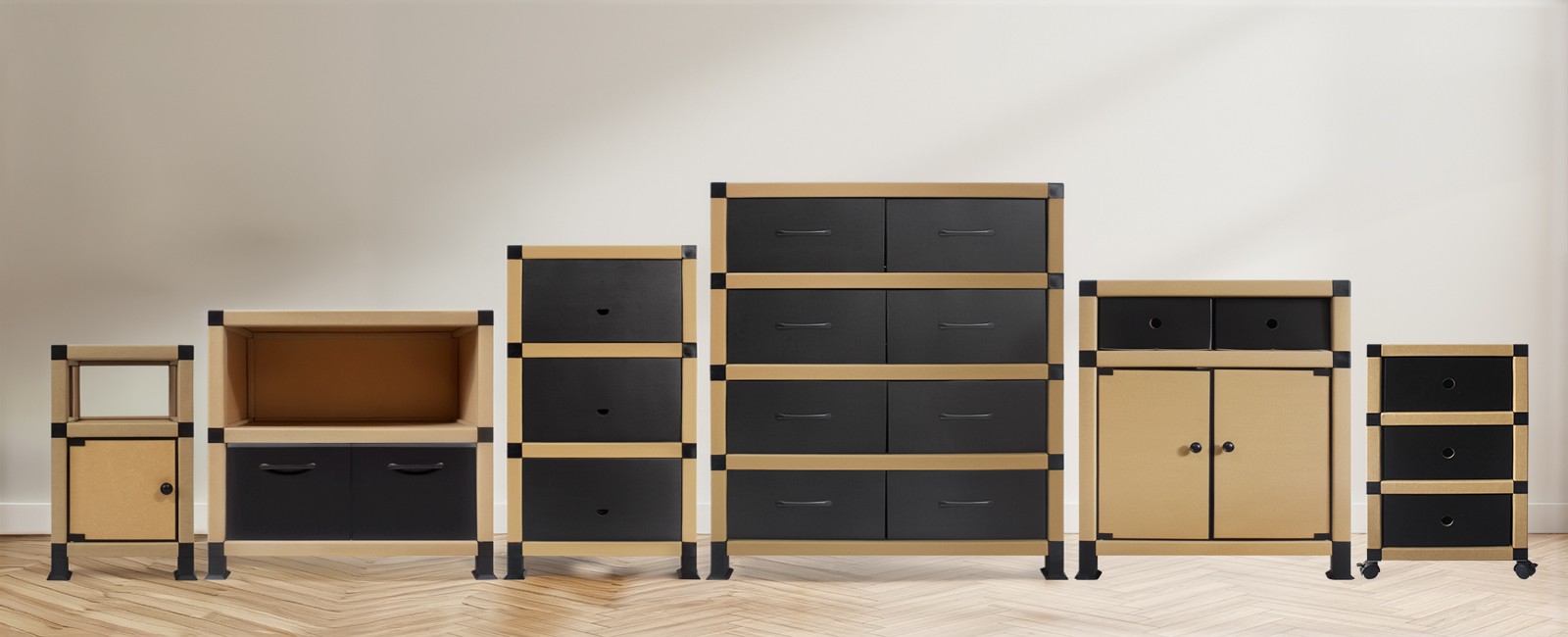
If you are setting up a playroom, you have probably spent hours comparing bookshelves made of wood, plastic, and metal. Then you stumble across the idea of a paper bookshelf, and the first thought is predictable: paper? For kids? It sounds fragile, maybe even gimmicky. But the reality is quite different. A well-engineered children's paper bookshelf is built from high-strength kraft paper tubes, reinforced panels, and multi-prong polypropylene connectors — the same structural logic used in commercial-grade modular furniture, just translated into recyclable materials. Before dismissing the idea, it helps to understand what these shelves actually are, how they perform in a real playroom, and whether they make sense for your family.
Forget the image of a cereal box taped together. Modern paper furniture is manufactured using three core components: high-strength paper tubes that serve as the structural frame, reinforced paper panels that form shelves and surfaces, and multi-prong connectors (3-way, 4-way, or 5-way) that lock everything together without screws or glue. The kraft paper used in these tubes goes through special treatment for water and stain resistance, and the connectors are designed to distribute weight evenly across the structure. This means a cardboard bookshelf from a reputable manufacturer is not a craft project — it is engineered furniture that happens to be made from recyclable paper.
For context, companies like MINHOU UNIMAX have been producing this type of furniture since 2009, holding patents on connector systems and maintaining FSC and BSCI certifications. Their bookcases come in configurations like a 5-tier model standing 176 cm tall or a compact 3-tier version at 109.5 cm — dimensions that compete directly with conventional bookshelves in terms of storage capacity.
In a playroom, safety is not a feature — it is the baseline. Children run, stumble, climb, and pull on everything within reach. A traditional wooden bookshelf of similar size can easily weigh several times more, and if it tips over, the consequences are serious. Paper furniture changes this equation in two ways.
First, weight. Paper furniture typically weighs only 20% to 30% as much as conventional furniture of comparable size. A bookshelf that a child can help push across the room is a bookshelf that causes far less harm if it falls. Second, the materials themselves have no sharp metal corners, no splinter-prone edges, and no heavy swinging doors. The rounded profiles of paper tubes and panels mean that even an accidental collision is more likely to result in a bumped ego than a real injury.
That said, anchoring is still good practice. Any freestanding shelf in a child's space — paper, wood, or metal — should be secured to the wall when possible. The difference is that with a paper bookshelf, you are dealing with something light enough to manage on your own.
Anyone who has assembled flat-pack furniture at midnight with an Allen wrench and a page of cryptic diagrams knows the frustration. Paper furniture eliminates this entirely. The connector systems snap together by hand — no tools, no hardware bags, no missing screws. A children's paper bookshelf can typically be assembled in minutes, and just as easily disassembled if you need to move it, store it, or reconfigure the playroom layout.
This matters especially for playrooms because the space evolves. What works for a toddler's board book collection at age three may need to become a craft supply station at age six. A bookshelf you can take apart and reassemble without damage gives you that flexibility without buying new furniture every couple of years.
A playroom is where children learn habits they carry for life. Choosing eco-friendly furniture made from recyclable, renewable paper materials is a tangible way to model environmental responsibility. Unlike particleboard — which relies on adhesives and laminates that complicate recycling — or plastic shelving that persists in landfills for centuries, paper furniture can be recycled at the end of its useful life. Manufacturers like MINHOU UNIMAX use kraft paper that is sourced through FSC-certified supply chains, and their production process is designed to generate less waste and consume less energy than conventional furniture manufacturing.
For parents who want to raise environmentally conscious kids, this is more than a purchasing decision. It is a conversation starter. When your child asks why their bookshelf is made of paper, you have a real answer about renewable materials, recycling, and reducing carbon footprints — not a slogan, but something they can see and touch every day.
These are the three questions every parent asks, and they deserve straight answers.
Durability: Paper furniture is not designed to last a lifetime, and honest manufacturers say so. The expected service life ranges from one to five years depending on use and environment, and can exceed five years under good conditions. For a playroom — a space that gets reconfigured every few years anyway — this is often a better fit than a heavy wooden shelf that outlasts its usefulness in that room and then becomes difficult to move or repurpose.
Load capacity: This is where many people are surprised. According to manufacturer specifications, a paper bookshelf can carry a total load of up to 50 kg distributed across its shelves. To put that in perspective, a bookshelf rated for 50 kg can hold dozens of children's hardcover picture books across its shelves — more than enough for a personal playroom library. Some structures in the same product line are rated to support an adult weighing up to 80 kg, which speaks to the underlying engineering. These are manufacturer claims and should be verified for the specific model, but they reflect the fact that high-strength paper tubes are not the same as corrugated cardboard boxes.
Moisture: The kraft paper used in quality paper furniture receives a surface treatment for water and stain resistance, and plastic foot covers protect the base from floor-level dampness. That said, paper furniture is not waterproof. You would not want it in a bathroom or an unsealed basement. In a typical playroom with controlled indoor humidity, it performs well. The practical guidance is straightforward: keep it away from direct water exposure, avoid placing it on damp floors, and address any surface coating damage promptly.
If you decide a paper bookshelf makes sense, here are the practical factors to weigh:
One advantage of choosing paper furniture from a manufacturer with a broad catalog is that you can build a coordinated playroom using the same material system. A paper bookshelf pairs naturally with a children's paper desk and seating set (a desk measuring 53.5 x 38.5 cm with a matching seat at 42 cm height), or with a paper game table that comes with four child-size seats — perfect for group activities. Multi-storage organizers with universal wheels can roll alongside the bookshelf to hold art supplies, puzzles, and toys. Because all of these pieces use the same paper tube and connector construction, the playroom looks cohesive rather than like a random collection of mismatched furniture.
Honesty matters here. A paper bookshelf is not the best choice if your playroom is in a humid, poorly ventilated basement. It is also not ideal if you need furniture that will survive rough handling from multiple older children who climb on everything — the load ratings are real, but they assume reasonable use. And if you are looking for a heirloom piece to pass down through generations, paper furniture is not designed for that role. It is built for a specific phase of life — the years when your child needs accessible, safe, flexible storage that you can assemble today and reconfigure next month.
So, should you buy a children's paper bookshelf for a playroom? For most families, the answer is yes — with the understanding of what it is and what it is not. It is lightweight, safe, recyclable, tool-free to assemble, and strong enough to hold a real library of children's books. It is not indestructible, not waterproof, and not designed to last decades. But for a playroom — a space defined by change, growth, and imagination — those trade-offs often work in its favor. You get furniture that adapts to your child's changing needs, teaches something about sustainability along the way, and costs less to buy and ship than conventional alternatives. If those priorities match yours, a paper bookshelf is not just a reasonable choice. It might be the smartest one.
