
If you are a retailer, brand manager, or event organizer exploring sustainable display solutions, one of the first questions you probably have is about cost. Cardboard furniture for retail display has emerged as a practical, eco-friendly alternative to traditional wood, metal, and plastic fixtures—but the price range can seem confusing at first glance. Some suppliers quote as little as a few dollars per unit, while others ask hundreds. This guide breaks down exactly what drives those numbers so you can budget with confidence.
The key thing to understand upfront is that "cardboard furniture for retail display" covers a broad spectrum. A simple corrugated POP display stand and a furniture-grade modular cabinet share the same raw material family, but they serve very different purposes and carry very different price tags. Let's look at what you can expect to pay.
Pricing for cardboard-based retail display products falls into three broad tiers. The ranges below reflect current market data from retail display suppliers and manufacturers:
For comparison: Traditional display furniture
Equivalent wood, metal, or plastic display fixtures typically cost $300 to $1,500 per unit and are often single-use or limited-reuse, adding disposal costs on top of the purchase price.
Understanding what drives price differences will help you make smarter purchasing decisions. Here are the six most important factors:
Not all cardboard is created equal. The foundation of any quality display furniture is the grade of kraft paper used. Higher-grade paper provides better load-bearing capacity, improved durability, and a stronger overall structure. Manufacturers specializing in cardboard furniture for retail display typically use high-strength paper tubes and reinforced panels that can support significant weight while remaining remarkably light.
Surface treatments also impact cost. Water-resistant and stain-resistant coatings—such as nano-coating—add to the per-unit price but extend usable life considerably. In retail environments where spills, humidity, and frequent handling are everyday realities, this investment pays for itself through longer service life.
The internal structure is one of the biggest cost drivers. A basic display may use a simple foldable design, while more advanced pieces incorporate reinforced base panels, double-layer shelves, and patented connector systems (such as 3-way and 4-way modular connectors) that improve load distribution and enable repeated assembly and disassembly.
These structural elements directly determine how much weight the furniture can hold. Well-engineered cardboard furniture can support an adult weighing up to 80 kg, and a bookshelf can carry a total load of 50 kg. This level of engineering costs more than a simple folding display but delivers far greater long-term value.
Physical dimensions have a direct impact on price. Larger pieces require more material and more complex engineering. Here is how common product types typically align with cost tiers:
Compact pieces (lower cost)
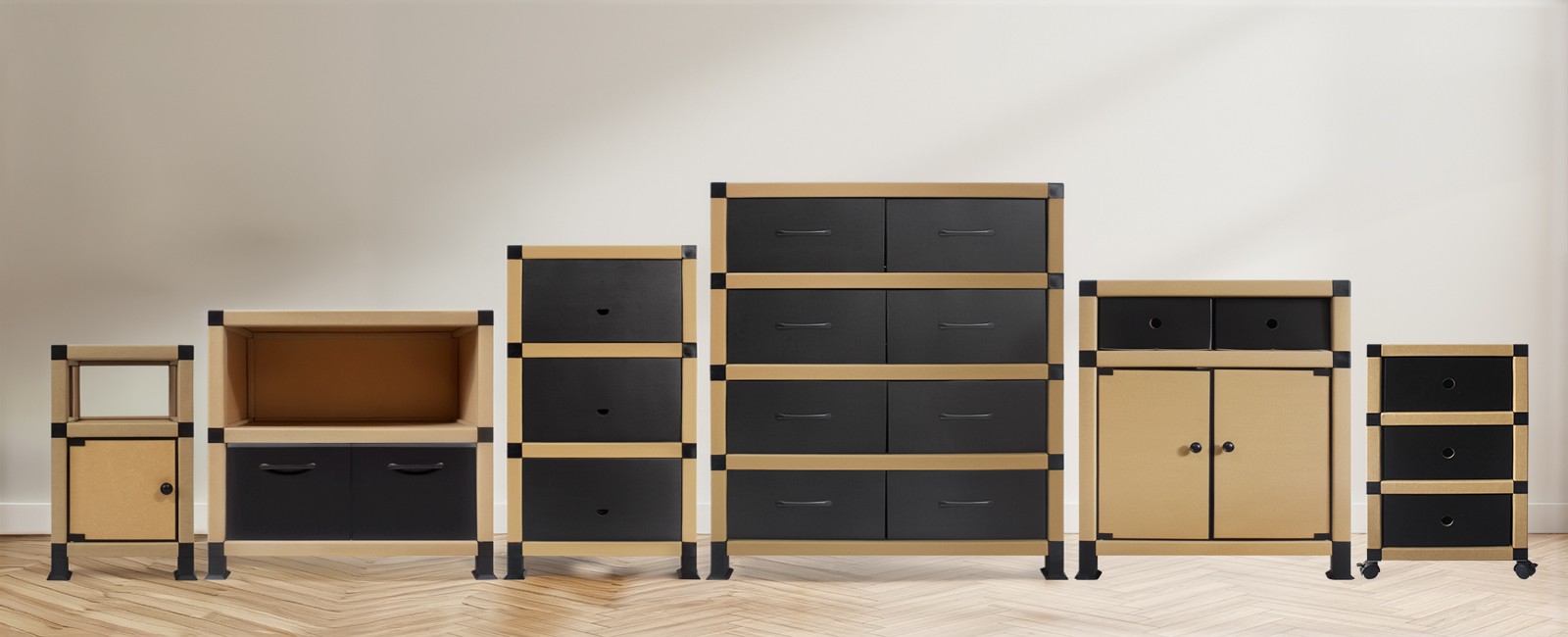
Paper end tables and narrow side tables measuring roughly 30–40 cm wide and 65–80 cm tall. These are ideal for checkout areas, small product showcases, or accent displays.
Medium pieces (mid-range cost)
Storage cabinets with doors and shelves, 6-cube organizers, and multi-storage units with wheels—typically 60–80 cm wide and 80–120 cm tall. These serve as primary display and storage fixtures in retail settings.
Large pieces (higher cost)
Full-height wardrobes, 9-cube storage organizers, and large storage shelves measuring over 120 cm wide and up to 144 cm tall. These require more material and stronger structural reinforcement but deliver maximum display capacity.
Order quantity has one of the most significant impacts on unit cost. Setup costs—printing plates, die-cut molds, and design work—are distributed across the total order. Small orders (under 50 units) carry the highest per-unit price, while large orders (500+ units) benefit from the lowest per-unit pricing.
For retailers planning long-term display programs across multiple locations, consolidating into a single larger order can substantially reduce overall cost. Many manufacturers offer tiered pricing, so a quote for 100 units may be noticeably lower per unit than a quote for 10 units of the same item.
Cardboard is essentially a blank canvas, which is one of its greatest advantages. However, customization adds cost. Standard stock designs are the most affordable option. Custom printing with your logo, brand colors, and patterns adds a moderate cost. Fully custom shapes and structures require new tooling and design work, pushing pricing higher. Special finishes like lamination, UV coating, or embossing carry premium pricing.
A practical tip: a clean, well-balanced design often performs better in retail than overly complex graphics—and costs less to produce. Many retailers find that a minimalist approach with strong brand colors and clear messaging delivers the best return on investment.
Shipping is frequently underestimated in pricing discussions but can make a substantial difference in total cost. This is where flat pack furniture has a major advantage. Well-designed cardboard display furniture ships flat-packed, meaning reduced shipping volume, lower freight costs, improved container efficiency for export orders, and reduced risk of damage during transit.
For international buyers, the flat-pack advantage is particularly significant. Cardboard furniture typically weighs only 20%–30% as much as traditional furniture, which means a shipment that fits in a single container may require multiple containers if the same items were shipped as pre-assembled wood or metal fixtures.
When evaluating cost, a side-by-side comparison helps put things in perspective:
| Factor | Traditional Displays (Wood/Plastic/Metal) | Cardboard Retail Furniture |
|---|---|---|
| Purchase Cost | $300 – $1,500 per unit | $50 – $300 per unit |
| Assembly Time | 2–4 hours (requires tools and team) | 30 minutes – 1 hour (tool-free, 1–2 people) |
| Shipping Volume | Bulky; often requires truck delivery | Flat-packed; fits in a car trunk |
| Weight | Full weight of wood/metal/plastic | Approximately 20%–30% of traditional furniture weight |
| Lifespan | Single-use or limited reuse | 1–5 years depending on conditions |
| Disposal | Landfill fees; non-recyclable in many cases | 100% recyclable and biodegradable |
| Customization | Expensive (custom cuts, painting, welding) | Affordable (easily printed, cut, and shaped) |
Looking only at the purchase price misses a significant part of the picture. The true cost of retail display furniture includes everything from shipping and assembly to storage and end-of-life disposal:
To maximize your budget when purchasing pop-up store display furniture, consider these strategies:
To get accurate pricing and avoid unnecessary revisions, be ready to share the following information with your supplier:
With this information, manufacturers can provide a precise quotation and recommend the most cost-effective structure and material combination for your specific situation.
The cost of cardboard furniture for retail display ranges from as little as $3 for simple POP stands to $300 or more for furniture-grade pieces, with the final price determined by material quality, structural design, size, order quantity, customization, and shipping. While the upfront cost of quality cardboard furniture may be higher than basic display stands, the total cost of ownership—including shipping savings, tool-free assembly, reuse potential, and zero disposal fees—often makes it the more economical choice over time. For retailers looking to combine sustainability with practical value, cardboard display furniture offers a compelling alternative to traditional materials. By understanding the factors that drive cost and working closely with an experienced manufacturer, you can create retail displays that fit your budget, perform reliably in-store, and align with your brand's environmental values.
