

When a wardrobe travels from a factory floor to a retailer's warehouse halfway across the world, the way it is packaged determines whether it arrives ready to sell or arrives damaged. Flat pack wardrobes — furniture designed to be disassembled into flat components for shipping — have transformed how furniture exporters manage shipping costs, container space, and product protection. For manufacturers of paper and cardboard furniture, flat-pack packaging is not just a shipping convenience; it is an integral part of the product design itself.
This article walks through the complete packaging process for a flat pack wardrobe for export, with a focus on the unique advantages that paper-based furniture brings to international shipping.
Before understanding the packaging process, it helps to know what components make up a flat pack paper wardrobe. Unlike traditional wooden wardrobes that ship as bulky assembled units, a paper wardrobe from MINHOU UNIMAX is engineered from three primary structural elements:
Each of these components is designed from the outset to be separated, stacked flat, and packed compactly. This is what makes flat pack furniture fundamentally different from conventional furniture when it comes to export logistics.
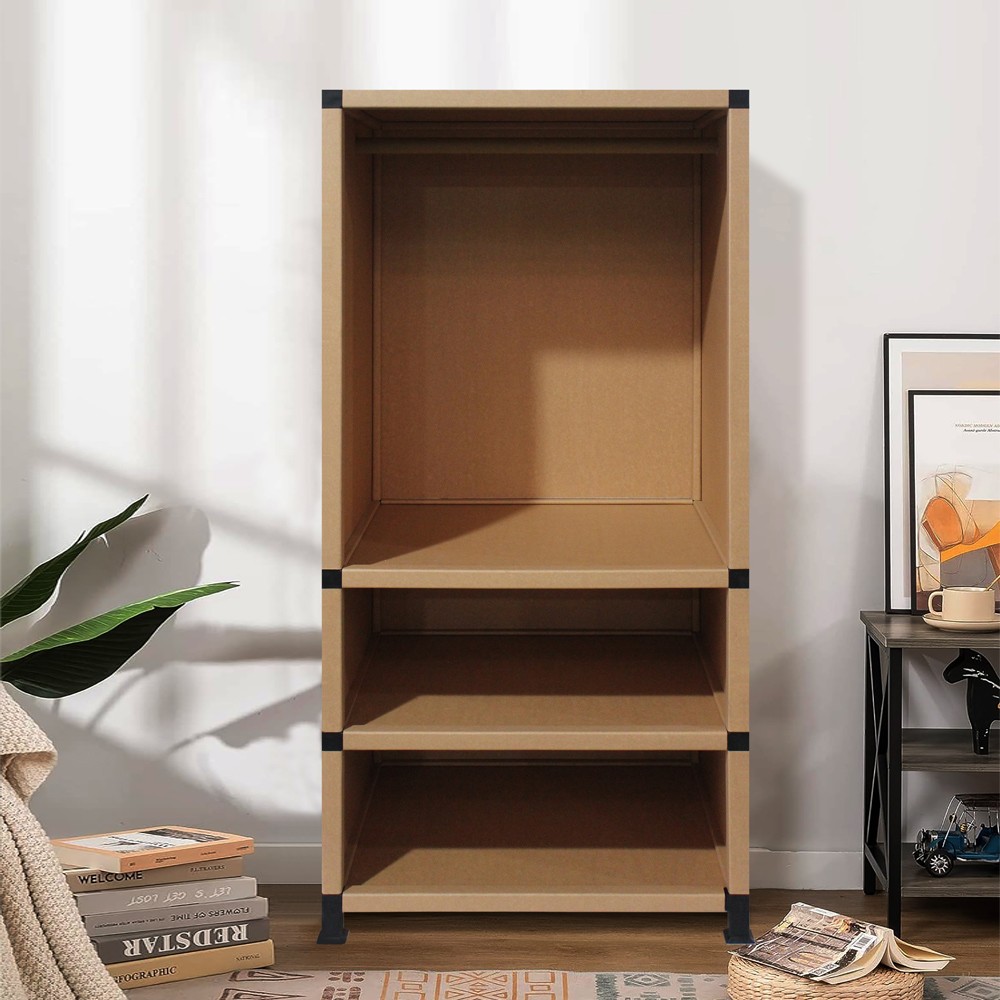
After quality inspection at the factory, each wardrobe is broken down into its constituent parts. Paper tubes are separated from panels, and connectors are removed and sorted. Unlike flat-pack wooden furniture that requires careful handling of heavy panels and fragile veneers, paper components are lightweight and resistant to surface scratching. This means the disassembly stage is faster and carries a lower risk of cosmetic damage.
The bedroom wardrobe line, for example, includes models ranging from a compact 67 × 37 × H116 cm closet to a full-height 77 × 65 × H160 cm wardrobe. Regardless of size, all models break down into the same three component types.
Components are sorted by type and grouped according to the quantity needed for each wardrobe unit. Connectors are counted and placed into separate bags or small boxes to prevent loss during transit. Any supplementary hardware is bagged separately and labeled. This organized approach ensures that the end recipient can easily identify and assemble all parts without confusion.
Flat-pack paper furniture components are wrapped to protect against moisture, dust, and abrasion during shipping:
For export shipments traveling by sea, moisture protection is especially important. The kraft paper used in these wardrobes receives special surface treatment for water and stain resistance, but additional wrapping during transit provides a second layer of defense against the high-humidity environment inside shipping containers.
All wrapped components for a single wardrobe are placed into a shipping carton. The packing follows a logical layering system:
The goal is to create a compact, stable package where nothing shifts inside the carton. Because paper furniture components are inherently lightweight — a full-size paper wardrobe weighs roughly 20–30% as much as a traditional wooden wardrobe of comparable dimensions — the cartons remain manageable in weight even when fully packed.
Cartons are sealed with packing tape and labeled with:
Clear labeling ensures that warehouse staff at the destination can quickly identify contents, verify completeness, and route the carton to the correct storage or assembly area.
For export, cartons are stacked onto pallets and secured with stretch film or strapping. The pallets are then loaded into shipping containers. Because flat-pack cartons are rectangular and uniform in shape, they stack efficiently with minimal wasted space. A single shipping container can hold significantly more flat-pack wardrobe units than assembled wardrobes, which directly reduces the per-unit shipping cost.
This is where the flat pack wardrobe for export delivers its strongest logistics advantage. By reducing the volume each unit occupies, exporters can maximize container utilization and lower the freight cost allocated to each wardrobe.
Paper-based flat pack wardrobes offer several distinct advantages over traditional wooden flat-pack furniture when it comes to export packaging:
Paper furniture weighs approximately 20–30% as much as traditional furniture. In ocean freight, where charges are often based on weight or volume (whichever is greater), lighter shipments directly translate to cost savings. A container loaded with paper wardrobes weighs far less than one loaded with wooden wardrobes, which can reduce fuel surcharges and overall shipping expenses.
Unlike wooden flat-pack furniture that relies on foam inserts, plastic wrap, and wooden pallets, paper furniture can be packaged using recyclable kraft paper and cardboard materials. This aligns with international packaging waste regulations, including the EU's Packaging and Packaging Waste Directive, and appeals to environmentally conscious retailers and consumers.
The multi-prong PP connector system means the wardrobe can be reassembled at the destination without screws, Allen keys, or power tools. This reduces the risk of missing hardware causing assembly delays and eliminates the need for specialized assembly labor at the destination warehouse.
Paper tubes, panels, and connectors pack down to a fraction of the assembled wardrobe's volume. This is not an afterthought — it is built into the product design from the beginning, with the modular connector system allowing every joint to be separated and reconnected repeatedly.
While flat-pack paper furniture is inherently well-suited for export, several protective measures ensure products arrive in excellent condition:
Shipping containers can experience significant humidity fluctuations during ocean transit. Paper furniture components receive water-resistant surface treatment during manufacturing, but exporters should still use moisture-barrier wrapping and, for long voyages, consider desiccant packets inside cartons. Keeping pallets off the container floor and away from condensation-prone areas further protects the shipment.
When stacking cartons on pallets, distribute weight evenly and avoid exceeding the load capacity of lower cartons. The company's product specifications indicate that selected structures can support an adult weighing up to 80 kg and a bookshelf can carry a total load of 50 kg, but these are use-phase ratings. Carton stacking limits should be based on the packed weight and carton strength, not the assembled product's load capacity.
Although paper panels are treated for water and stain resistance, the surface coating can be damaged by sharp impacts or excessive friction. Interleaving sheets between panels and avoiding over-tight strapping on pallets prevents surface damage during transit.
Flat-pack packaging reduces the volumetric footprint of each wardrobe by a substantial margin compared to assembled furniture. For exporters, this means:
| Factor | Assembled Wardrobe | Flat Pack Paper Wardrobe |
|---|---|---|
| Units per 20ft container | Limited by volume | Significantly more units |
| Per-unit freight cost | Higher (fewer units share container cost) | Lower (more units share container cost) |
| Shipment weight | Heavy (dense wood/MDF materials) | Light (20–30% of traditional weight) |
| Transit damage risk | Higher (doors, joints, and panels stressed) | Lower (components packed flat and stable) |
| Packaging recyclability | Often mixed materials (foam, plastic, wood) | Recyclable paper and cardboard |
For paper furniture specifically, the lightweight nature of the materials compounds these savings. Lower total shipment weight can reduce freight charges on weight-based routes and lower fuel-related surcharges.
Export packaging is increasingly subject to environmental regulations in destination markets. Paper furniture offers a natural advantage:
These factors make paper flat-pack wardrobes particularly attractive for retailers and distributors in markets with strict packaging waste regulations and growing consumer demand for sustainable products.
The way a flat pack wardrobe is packaged for export is not just about fitting pieces into a box — it is about designing a product that ships efficiently, arrives intact, and assembles easily at the destination. Paper-based flat pack wardrobes from MINHOU UNIMAX are engineered from the ground up for this purpose, combining lightweight kraft paper tubes, reinforced panels, and patented tool-free connectors into a packaging system that reduces shipping costs, minimizes environmental impact, and delivers a product ready for immediate assembly.
For retailers, distributors, and importers looking for export-ready furniture that balances cost, sustainability, and logistics efficiency, paper flat-pack wardrobes offer a compelling solution. Explore the full range of bedroom wardrobes and discover how flat pack furniture design can streamline your next furniture import.
