
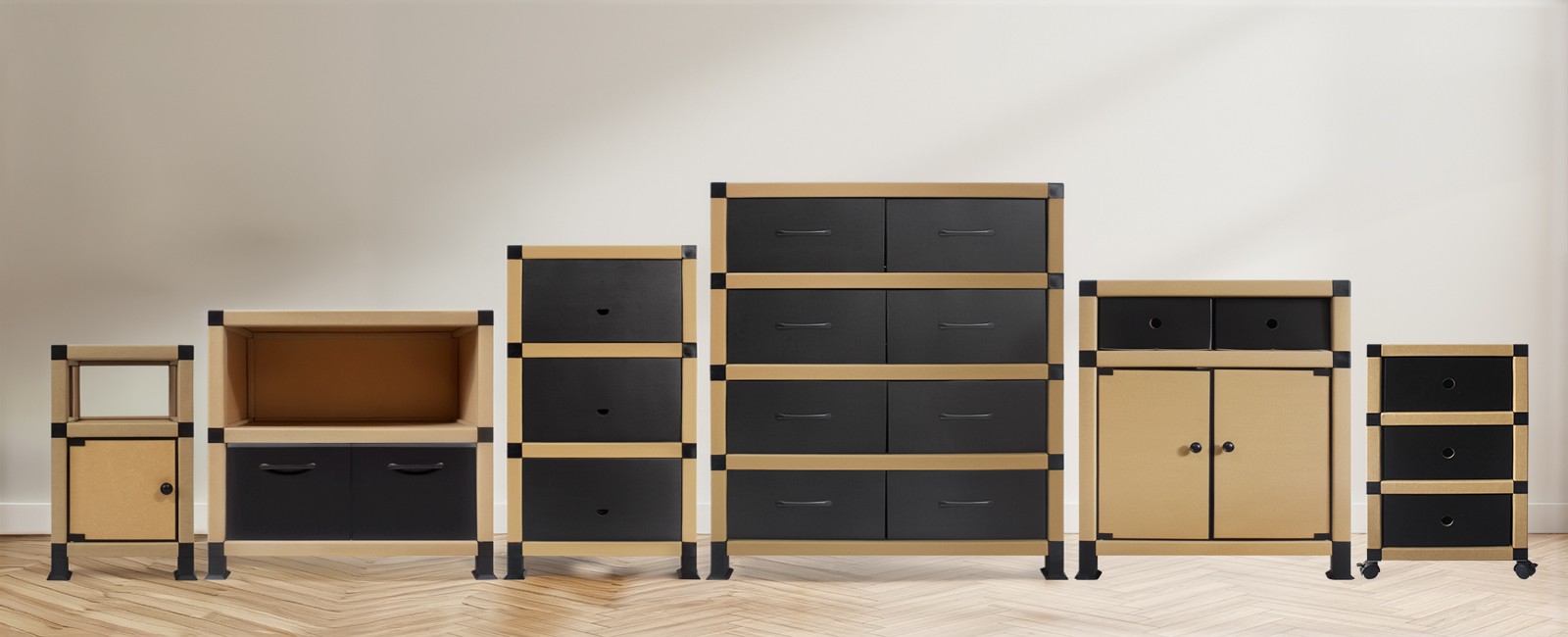
When sourcing wardrobes for international markets, buyers often weigh two popular options: the traditional flat pack furniture wardrobe built from engineered wood, and the newer paper wardrobe made from high-strength kraft paper tubes and panels. Both arrive disassembled and both target cost-conscious, space-aware consumers — but they differ sharply in materials, logistics, assembly, sustainability, and total cost of ownership. This article breaks down how a flat pack wardrobe for export compares to a paper wardrobe so that retailers, distributors, and sourcing managers can make an informed decision.
A conventional flat pack wardrobe for export is a ready-to-assemble closet shipped in compact, disassembled cartons. The panels are typically made from particleboard or medium-density fiberboard (MDF), connected with cam locks, dowel pins, and metal brackets. Originating from the Scandinavian furniture model popularized by IKEA, these wardrobes are designed to be affordable, relatively stylish, and space-efficient during transport.
For exporters, the appeal is clear: flat pack packaging reduces shipping volume compared to fully assembled furniture, allowing more units per container. However, the wood-based panels still carry significant weight. A typical 150 cm flat pack wardrobe in particleboard weighs 25 to 40 kg, which means each carton requires careful handling, and total container loads remain limited by weight ceilings. Assembly also requires tools — usually a screwdriver, hammer, and sometimes a drill — and can take two to five hours depending on complexity.
A paper wardrobe is a modular closet constructed from high-strength kraft paper tubes, reinforced paper panels, and multi-prong polypropylene (PP) connectors. Rather than using wood, metal, or plastic as primary structural materials, it engineers paper — a renewable, recyclable resource — into load-bearing furniture through patented connector systems and specialized surface treatments.
Manufacturers such as MINHOU UNIMAX have refined this concept since 2009, producing paper wardrobe for bedroom use that weighs roughly 20 to 30 percent of a comparable wooden wardrobe. The foldable paper wardrobe arrives flat-packed, assembles without any tools in minutes, and can be disassembled and reassembled multiple times without structural degradation.
The fundamental difference between these two wardrobe types lies in their core materials and how those materials are engineered into a usable structure.
| Aspect | Flat Pack Wood Wardrobe | Paper Wardrobe (e.g., MINHOU UNIMAX) |
|---|---|---|
| Primary material | Particleboard or MDF (15–18 mm) | High-strength kraft paper tubes and reinforced panels |
| Connectors | Cam locks, dowel pins, metal brackets | Patented multi-prong PP (3-way and 4-way) connectors |
| Surface treatment | Melamine laminate or veneer | Water- and stain-resistant coating on kraft paper |
| Chemical concerns | May contain formaldehyde-based resins (look for CARB P2 or E1 compliance) | Tested for formaldehyde, POP/PCP, cadmium, and phthalates; FSC-certified materials |
| Recyclability | Difficult to recycle due to mixed materials (wood, glue, metal, plastic) | 100% recyclable as paper-based material |
Particleboard wardrobes depend on adhesives and resins to hold wood fibers together, which introduces formaldehyde emission concerns. Buyers sourcing for markets with strict indoor air quality regulations — such as the EU, California, or Japan — need to verify compliance certificates for every shipment. Paper wardrobes, by contrast, use mechanical interlocking connectors rather than glues, and reputable manufacturers provide test reports covering formaldehyde and heavy substances.
Weight is one of the most impactful differences for export logistics. A standard particleboard wardrobe measuring roughly 150 cm wide typically weighs between 25 and 40 kg. Moving it requires two people, and shipping costs scale with weight.
Paper wardrobes from MINHOU UNIMAX weigh approximately 20 to 30 percent of their wooden counterparts. A full-height paper wardrobe (160 cm tall, 77 cm wide) can be carried by one person. This weight reduction translates directly into lower per-unit freight costs and easier last-mile delivery, especially in markets where labor costs for handling are high.
Paper Wardrobe Weight Advantages
Flat Pack Wood Wardrobe Weight Drawbacks
Assembly complexity is a major factor in customer satisfaction, especially for e-commerce retail where returns due to assembly frustration are costly.
Traditional flat pack wardrobes require a Phillips screwdriver, rubber mallet, and sometimes a power drill. Assembly typically takes two to five hours, often requiring two people. Instructions can be ambiguous, and misaligned cam locks or stripped screws are common pain points that lead to negative reviews and returns.
Paper wardrobes use a slot-and-lock system where panels slide into pre-cut positions and multi-prong connectors snap into place. No tools are needed. Assembly takes 10 to 15 minutes for a single person. The mechanical connector system also allows repeated disassembly and reassembly — useful for renters, students, or anyone who moves frequently — without the screw-hole widening that undermines flat pack wood furniture after two or three relocations.
Both wardrobe types ship flat-packed, but the paper wardrobe achieves a dramatically smaller shipping volume. Paper tubes, panels, and connectors pack separately into compact cartons that can be stacked efficiently. Because the materials themselves are lighter and thinner than particleboard, a single shipping container can hold significantly more paper wardrobe units than wooden flat pack wardrobes.
For exporters, this means:
Additionally, paper wardrobe components are less susceptible to the edge chipping and panel cracking that affect particleboard during rough transit. While wooden flat pack panels can arrive cracked or scratched — a frequent source of customer complaints — paper tubes and panels flex slightly under impact and are packed to minimize contact damage.
Durability is where many buyers have the most questions about paper furniture. The reality is more nuanced than the assumption that paper equals fragile.
Flat pack particleboard wardrobes typically last 3 to 7 years. Their weak points are the cam lock connections, which loosen over time, and the laminate edges, which peel with moisture exposure. After two or three moves, screw holes widen and the structure becomes unstable. MDF is particularly vulnerable to swelling if exposed to humidity.
Paper wardrobes from MINHOU UNIMAX use high-strength kraft paper that has been treated for water and stain resistance. The patented three-way and multi-prong connector systems distribute load across multiple contact points rather than concentrating it on single screws. According to the manufacturer's published specifications, selected structures can support an adult weighing up to 80 kg, and a bookshelf configuration can carry a total load of 50 kg. The expected service life is 1 to 5 years depending on usage and environment, with the potential to exceed five years under suitable conditions.
Key distinction: Paper wardrobes are positioned for light-use, storage, transitional, and flexible-space applications. They are not designed to replace permanent heavy-load core furniture. For buyers serving rental apartments, student housing, temporary installations, or pop-up retail, the durability profile is well-matched to the use case. For buyers targeting permanent residential installations, traditional wood wardrobes still hold an advantage in long-term load stability.
Sustainability is increasingly driving purchasing decisions, particularly in European and North American markets where consumers and regulators scrutinize the environmental footprint of imported goods.
| Sustainability Factor | Flat Pack Wood Wardrobe | Paper Wardrobe |
|---|---|---|
| Raw material source | Wood fibers bonded with resins; may use virgin or recycled wood | Kraft paper from renewable sources; FSC-certified available |
| Manufacturing energy | Higher energy for pressing, cutting, and laminating | Lower-energy production (paper rolling, cutting, coating) |
| End-of-life disposal | Difficult to separate wood, glue, and hardware; mostly landfilled | 100% recyclable as paper; biodegradable |
| Certifications | Variable; CARB P2 or E1 for emissions | FSC and BSCI membership; test reports for formaldehyde, heavy substances |
| Carbon footprint per unit shipped | Higher (heavier weight, more energy-intensive materials) | Lower (lighter weight, renewable material, efficient packing) |
For exporters targeting markets with extended producer responsibility (EPR) regulations or carbon border adjustment mechanisms, the lower manufacturing energy and higher recyclability of paper wardrobes can translate into tangible compliance and cost advantages.
At first glance, budget-tier flat pack wood wardrobes appear cheaper. Entry-level particleboard models can retail for as little as $80 to $120. However, the total cost of ownership tells a different story when export logistics are factored in.
For wholesalers and distributors, the relevant cost metrics include:
For the end consumer, a paper wardrobe typically costs less than a mid-range wooden flat pack wardrobe while offering faster assembly and greater portability. The trade-off is a shorter expected lifespan, making paper wardrobes ideal for transitional living situations rather than permanent installations.
Flat pack wood wardrobes offer a range of laminate finishes — white, oak, walnut, gray — and some premium models include soft-close hinges and integrated lighting. However, dimensions are fixed, and post-purchase modifications are difficult.
Paper wardrobes offer a different kind of flexibility. The modular connector system allows buyers to reconfigure shelf positions, add or remove tiers, and combine units into larger storage systems. Surface appearance can be customized through printing or coating options. For retailers offering private-label furniture, paper wardrobes provide a versatile platform for branded finishes without the tooling investment required for wood furniture.
Understanding where each wardrobe type excels helps buyers align product selection with their target market:
| Use Case | Recommended Type | Why |
|---|---|---|
| Rental apartments and student housing | Paper wardrobe | Lightweight, tool-free, easy to move and disassemble |
| Temporary exhibitions and pop-up stores | Paper wardrobe | Fast setup, low cost, recyclable after use |
| Export to high-humidity markets | Either (with treatment) | Paper needs water-resistant coating; MDF needs sealed edges |
| Permanent residential bedroom | Flat pack wood wardrobe | Longer lifespan, higher load capacity for daily use |
| Eco-conscious retail lines | Paper wardrobe | Recyclable, renewable, lower carbon footprint, FSC-certified |
| Budget bulk furnishing (hostels, dorms) | Paper wardrobe | Lower per-unit logistics cost, faster assembly at scale |
The comparison between a flat pack wardrobe for export and a paper wardrobe is not a question of one being universally better than the other — it is a question of fit. For buyers serving permanent residential markets where decades-long durability and heavy daily load capacity are priorities, traditional flat pack wood wardrobes remain a solid choice. For buyers targeting rental housing, student accommodation, eco-conscious consumers, temporary installations, or cost-sensitive export markets, paper wardrobes offer a compelling combination of lower shipping weight, tool-free assembly, full recyclability, and competitive per-unit logistics costs. The paper wardrobe does not replace the wooden wardrobe — it occupies a distinct and growing segment where portability, sustainability, and assembly simplicity matter more than maximum lifespan.
If you are evaluating paper wardrobe options for your retail line or export market, MINHOU UNIMAX offers a catalog of bedroom wardrobes, storage cabinets, and organizers built from high-strength kraft paper with patented connector systems. To explore available models, specifications, and customization options, visit the bedroom wardrobe collection or contact the team at fz-unimax.com.
