
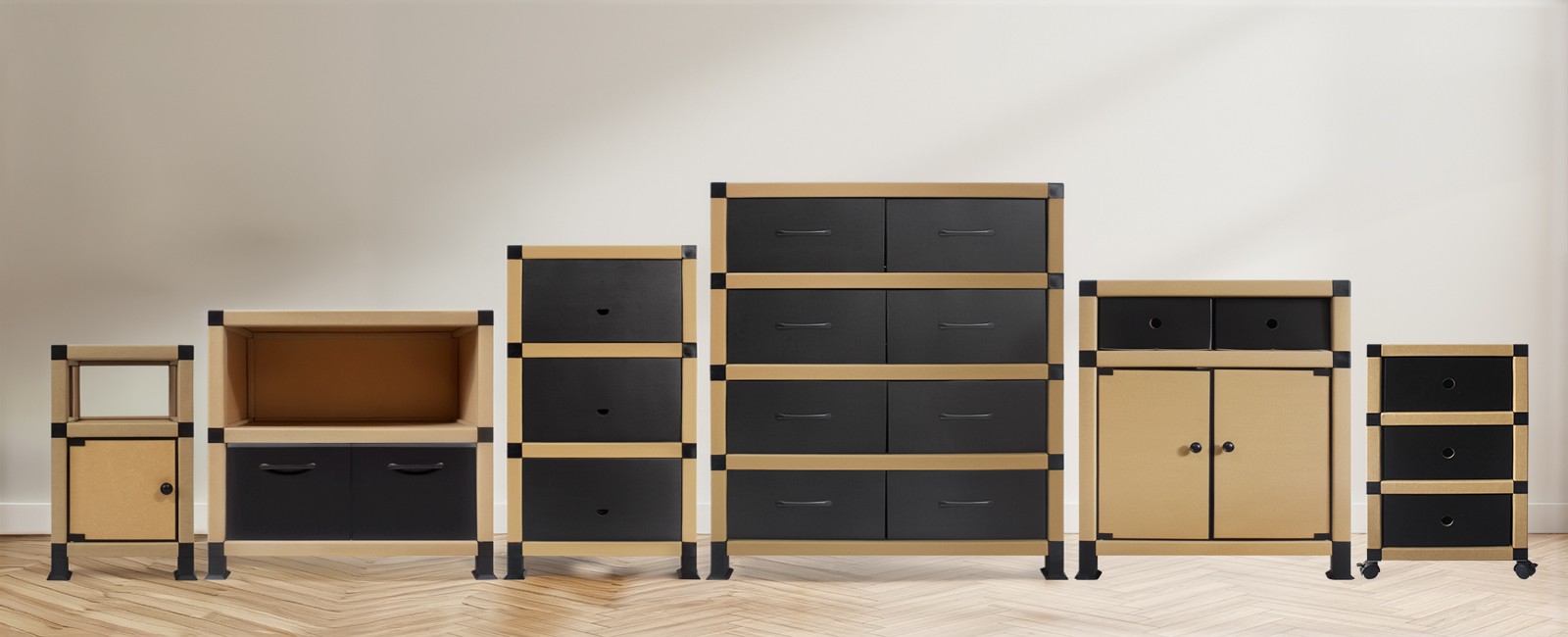
A bookshelf rarely stays the way you first set it up. Books end up stacked on their sides because the upright row ran out of room, a phone charger lands on the nearest flat surface, and before long accessories that belong nowhere in particular take up a third of the shelf. The question is not just how to fit more on a bookshelf, but how one piece of furniture can keep books and accessories in order at the same time. A paper bookcase built from high-strength kraft paper tubes, reinforced panels, and multi-prong connectors answers that question with a storage unit that is light enough to reposition, strong enough to hold a real library, and simple enough to assemble without a single tool.
Before diving into organizing strategy, it helps to understand why a paper bookshelf storage unit is well suited to the job of managing both books and accessories. Conventional wooden or metal bookcases are heavy, hard to move once filled, and often too permanent for renters, students, or anyone who rearranges a room every few months. A well-engineered paper furniture unit flips those limitations around.
These characteristics matter for organization because they give you flexibility. You can move a half-loaded shelf to vacuum behind it, add a second matching unit when the collection grows, or reposition the whole bookcase to a new wall without hiring help. Organization is easier when the furniture cooperates with you.
1Pulling everything off the shelves sounds like it creates more work, but it is the fastest way to reset. An empty bookcase reveals the true dimensions of each tier, lets you wipe down the water-resistant surface, and gives you a chance to check that every connector is still seated firmly.
With everything on the floor, sort items into three groups: keep on the shelf, store elsewhere, and donate or recycle. Books you have not opened in years and accessories you no longer use belong in the donate pile. Seasonal or sentimental items can move to a closed storage cabinet so they stop competing for open-shelf space. What remains is your working collection, and it is usually smaller than you expected.
2The best sorting method depends on how you actually look for things. Pick one primary rule and apply it consistently so every book and accessory has an obvious home.
| Sorting Method | Primary Benefit | Best Suited For |
|---|---|---|
| By genre or subject | Natural browsing by mood or topic | Mixed home libraries and study rooms |
| Alphabetical by author | Fast retrieval of a specific title | Home offices and reference collections |
| By size (tall to short) | Maximizes vertical space, looks streamlined | Minimalist shelves with varied book heights |
| By color | Creates a decorative focal point | Living-room display shelves |
A hybrid approach works well for most homes. Group books into broad categories first, then apply a secondary rule within each group. For accessories, assign each category its own tier or section so a basket of cables never migrates into the novels.
3Think of the bookcase in three vertical zones. Each zone serves a different purpose, and placing items in the right zone keeps the unit stable and everything within easy reach.
Place the heaviest books, such as encyclopedias and large art volumes, on the lowest tiers. This lowers the center of gravity and keeps the tall unit stable. If children use the bookcase, reserve the bottom one or two shelves for their board books, favorite chapter books, and small fabric baskets for toys so they can browse and return items without help.
Eye level and waist level are the most effortless spots to reach, so reserve them for the books and accessories you touch most often: the novel you are currently reading, cookbooks used weekly, notebooks, or a charging station for your phone. A 5-tier paper bookshelf places two or three tiers right in this comfortable zone, which is where daily organization pays off the most.
The upper tiers suit fragile decor, books you rarely reach for, and accessories you want to display rather than handle. Because paper furniture is lightweight, you can still move the whole unit to access the top without straining, but keep the heaviest objects lower for safety.
4Most bookshelves default to all-vertical rows, which look stiff and leave tall gaps above shorter paperbacks. Break the pattern by placing a small horizontal stack of three to five books flat every few sections. These flat stacks serve double duty: they act as natural bookends for the upright books on either side, and they raise the surface level so you can rest a small plant, a candle, or a framed photo on top.
Alternate the pattern across tiers so the eye moves naturally instead of scanning a uniform wall of spines. This simple technique turns a storage unit into something that looks intentional without requiring any design background.
5A shelf that is completely packed with books looks heavy and leaves no room for growth. A shelf crowded with knick-knacks looks like a storage unit rather than a library. The sweet spot is roughly 70 percent books and 30 percent objects, leaving about a third of each tier open so the display feels lighter and new additions do not trigger a full reorganization.
When placing accessories, group them in odd numbers. Three objects at different heights tend to look more balanced than two or four. Useful accessories that pair naturally with books on a paper bookshelf include:
6Open shelves are perfect for books and display pieces, but accessories that are purely functional, like cables, paperwork, or craft supplies, look messy if they sit in the open. The solution is to pair the bookcase with a complementary storage cabinet that offers closed compartments.
A paper storage cabinet with doors and an open shelf combines enclosed storage that protects items from dust with a quick-access display surface on top. For items that move between rooms, a wheeled paper organizer lets you roll supplies to wherever you are working and tuck them out of sight afterward. Because these units use the same connector system and kraft-paper finish, they look like a coordinated set rather than mismatched furniture.
| Accessory Type | Recommended Storage | Why It Works |
|---|---|---|
| Books on display | Open paper bookcase tiers | Visible spines, easy browsing, 50 kg load capacity |
| Chargers, cables, remotes | Basket on open shelf or drawer in cabinet | Keeps clutter contained yet reachable |
| Documents and paperwork | Closed cabinet with doors | Protects paper from dust and moisture |
| Craft or office supplies | Wheeled organizer | Rolls to the work area, then out of sight |
| Children's books and toys | Bottom tiers of bookcase | Kid-height access, lightweight and safe |
The combination of low weight, tool-free assembly, and flat-pack design makes paper bookshelves especially practical in settings where conventional furniture is impractical:
Organization only holds if the furniture stays in good condition. Paper furniture is designed for light to medium use and performs best with a few simple care habits:
With reasonable care, a paper bookshelf commonly lasts one to five years depending on use and environment, and the service life can exceed five years under suitable conditions. For light-use, storage, and display purposes, that is more than enough to justify the low cost and full recyclability.
Can a paper bookshelf really hold heavy books?
Yes. The manufacturer states that its bookshelf structures can support a total load of up to 50 kg when weight is distributed evenly. Reinforced paper panels and patented three-way connectors spread the load across the frame. Place the heaviest volumes on the bottom tiers for stability.
How do I keep accessories from making the bookshelf look cluttered?
Follow the 70/30 rule: roughly 70 percent books and 30 percent objects, leaving a third of each tier open. Group accessories in odd numbers, use baskets to contain loose items, and move purely functional accessories into a closed cabinet so only display-worthy objects stay visible.
Is a paper bookcase suitable for a rental apartment?
It is one of the best choices for renters. The unit assembles and disassembles without tools, leaves no wall damage, and flat-packs into a carton for moving. Its light weight also means one person can reposition it even when it is partially loaded.
How full should each shelf be?
Leave about a third of each tier open. A fully packed shelf leaves no room for new books and makes every small addition look messy. Open space keeps the display feeling light and makes individual items easier to spot.
Can children use a paper bookshelf safely?
Yes, with basic precautions. Reserve the bottom shelves for children's books and toys so kids can reach them independently. Keep fragile or heavy items on upper shelves, ensure all connectors are seated firmly, and place the heaviest objects low to keep the unit stable.
What happens when the bookshelf reaches the end of its life?
Because the unit is made from kraft paper tubes, reinforced paper panels, and polypropylene connectors, it can be disassembled and recycled. Avoid mixing in non-paper materials during use so recycling stays straightforward at the end of the service life.
A paper bookshelf storage unit organizes both books and accessories by giving every item a defined zone: heavy books on the bottom, daily-use items at eye level, display pieces on top, and functional accessories tucked into closed storage. The tool-free, lightweight, flat-pack design means the system adapts as the collection grows or the room changes, while the water-resistant kraft-paper surface and load-bearing connectors keep it practical for everyday use. Sort once, zone the shelves by height, mix vertical and horizontal stacks, and pair open tiers with a closed cabinet, and a single paper bookcase can keep an entire room's worth of books and accessories in order.
